-
1964
The new Sycamore Street factory is built. -
1969
Brazilian rosewood is discontinued on stock model Martin guitars. -
1968
The D-45 returns to the Martin lineup. -
1931
Martin introduces the Dreadnought under the Martin name.
1931
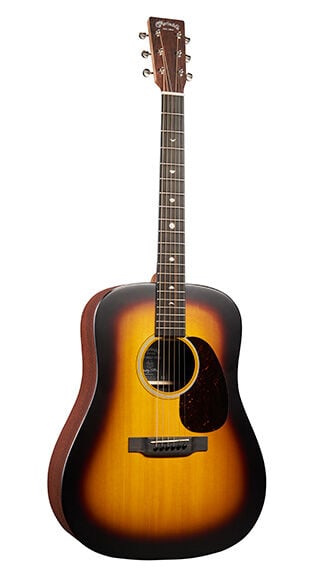
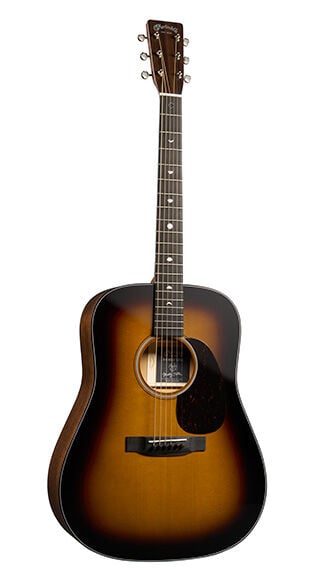
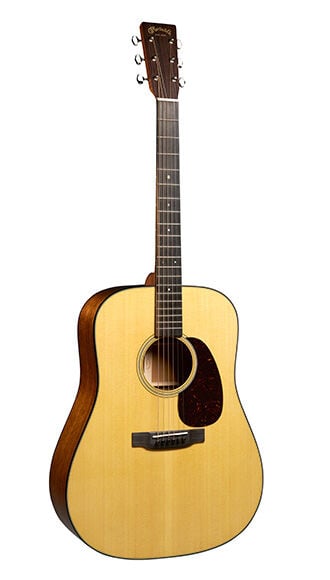
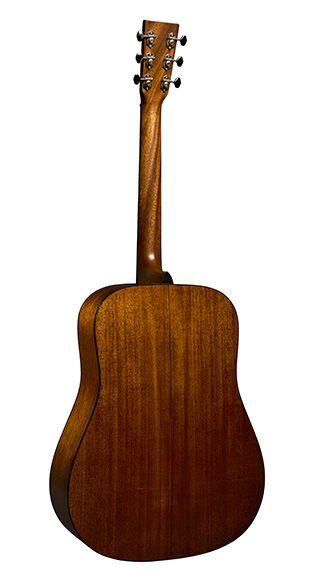
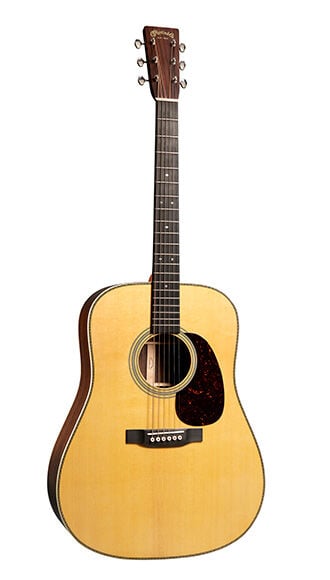
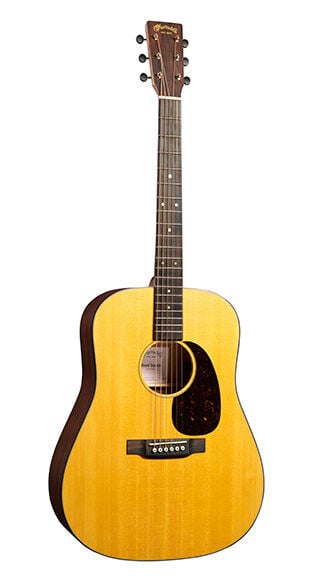
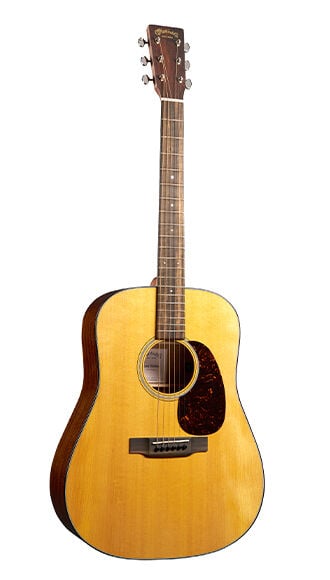
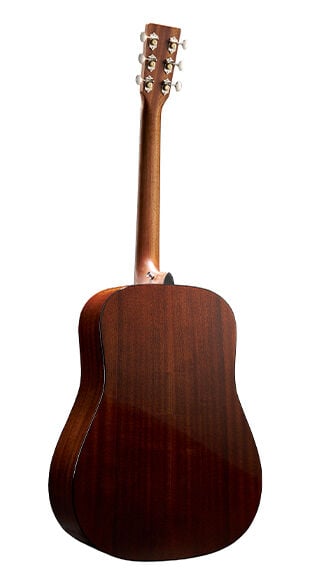
The Ditson Company fails after the Great Depression. Martin introduces their own version of the Dreadnought guitar as the 12-fret D-1 and D-2 models, later becoming the D-18 (shown) and D-28. Other makers begin to copy the design — and even the name. A Martin original, the Dreadnought is the most copied and popular guitar design in the world.
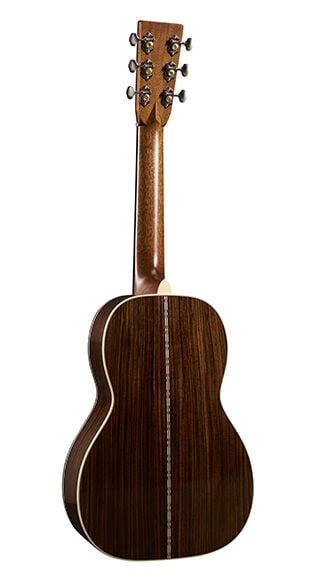
Martin builds first series of archtop guitars. Never as successful as flattops, sporadic production ends in 1942.
-
1933
Frank Herbert Martin is born. The first Martin D-45 and D-28 appear.
1933
Frank Herbert Martin, the fifth generation of Martins in America, is born in 1933. He is shown here as a boy with his father (C. F. Martin III) and grandfather (Frank Henry Martin).
Martin custom builds the first D-45 for cowboy star Gene Autry, 12-fret body, Serial #53177. Legions of "Singing Cowboys" – including Roy Rodgers – follow Gene’s lead, ordering fancy pearl-bound Martins for the silver screen.
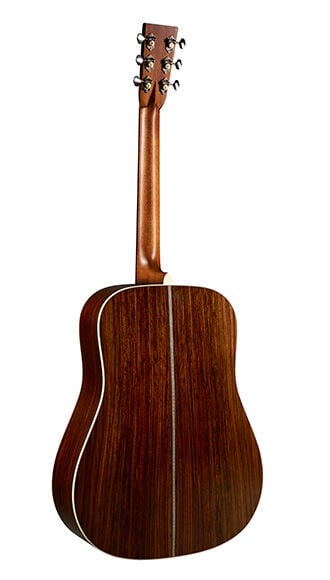
The original Herringbone D-28 (so called because of its herringbone wood trim) is also introduced and features scalloped top bracing which greatly increased its tone and volume. It becomes one of the most sought-after Martins by collectors and players.
-
1937
The first 14-fret D-45 is introduced. -
1940s
Country music starts to sweep the land. -
1944
World War II causes supply problems. -
1945
C. F. Martin III takes the helm.
1945
C. F. Martin, III, learned about guitar making from his father, and from the workmen on the staff. He never became a complete guitar maker in the sense that others were at that time, but he did have a couple of guitars he made with the assistance of his fellow workmen. He shaped necks, fretted fingerboards, polished the finished guitars, and put braces on tops. He did almost everything except that he did not regularly assemble bodies, meaning the installing of the top and back on the frame.
In those years he also did pearl and ivory work. The pearl was cut by hand right out of the abalone shell. Young Mr. Martin also cut the ivory strips out of tusks brought in from New York where they had been imported. He made the ivory friction pegs formerly used on some Martin guitars. This was all part of the guitar business.
By the 1930's C.F. Martin, III, had taken over many of the important duties. This was a very difficult period, and everyone had to work hard. There was only one assistant in the office, Miss Maude Menhennitt. Frederick, as he was called, did most of the letter writing. His father was the President and Manager and Frederick had the title of Superintendent of the plant. He was very close to the men in those days. Every morning he went around and spoke to everybody. He knew what was going on at all times. The quality of the guitars was very closely watched then, as it is now.
C.F. Martin III assumed the presidency after the death of his father. Prior to that he had been active in the war effort as Chairman of the local Selective Services Board.
-
1948
Frank Henry Martin passes away.
1948
Frank Henry Martin's legacy is immeasurable, brilliantly guiding the company through two world wars, a depression, shortages of materials, while still capitalizing on succession of major musical trends.
Frank Henry Martin put his heart and soul into the guitar business. He never had the opportunity of going to college because he had to take over the business. He did, however, study Latin and other subjects at home. He also read a lot, such books as "The Decline and Fall of the Roman Empire."
Difficult as it may have been, he found time for still more activities. He was an officer in the Moravian Church. He served as a member and secretary of the school board in Nazareth.
He spent all of his life in the guitar business, having been trained by his father as a guitar maker. He was skillful with his hands and liked to do woodwork as a hobby. In the evenings he would, with a scroll saw, cut intricate designs for bookshelves and sewing baskets. That sort of thing he liked to do, because he loved wood.
Mr. F.H. Martin was not a musician, but he could sing fairly well. He never learned to play the guitar other than a few chords. He was a guitar maker, not a guitar player. He had a mother and four unmarried sisters to support. The sisters' names were according to their age; Agnes, Laura, Anna, and Harriet. Agnes and Harriet were married within a few years, but the other two never were married.
Mr. Martin retired about 1945 but he kept his desk in the office and was there a great deal. He was an active man and continued to influence the business until about 1947. He would probably have retired earlier, but his son Frederick had been heavily involved in activities concerning the war effort.
Walking was one of his favorite activities. He would take daily walks, some many miles in length. About this time a road was being put in between Nazareth and Wind Gap. According to his wife, the former Miss Jennie Keller, he took a great interest in this construction and would walk up to check on its progress whenever the weather permitted.
Mr. Frank Henry Martin passed away April 9, 1948. This was a great loss, not only to his loved ones, but also to the community. He had accomplished the feat of turning a small guitar shop controlled by outside interests into a thriving family owned and controlled business. His guitars were known and respected throughout the world. He was a proud man, and a truly successful businessman.
-
1950s
The Folk Music Boom begins. -
1954
Elvis shakes up the nation. -
1955
Frank Herbert Martin joins the company.
1955
Christian Frederick Martin, IV, is born on July 8, 1955, son of Frank Herbert Martin and his first wife, Joan Simms Martin.
Chris attended Montclair Academy at Montclair, New Jersey, Lyndhurst High School in Lyndhurst, New Jersey and Pleasant Valley High School in Brodheadsville, Pa. He then attended U.C.L.A., majoring in Economics. In his free time he helped in the guitar repair shop of Westwood Music in West Los Angeles, and this also gave him a valuable insight into the retail end of the music business.
When Chris was small he helped box strings, 6 to a box. In 1972 and 1973 he became more active in the business, helping in the office and attending the large Trade Show in Chicago. He also worked a little in the machine room cutting out guitar neck blanks on a bandsaw. Chris now freely admits being responsible for some crayfish that mysteriously showed up in the secretaries desks during the 1960's.
During the summer of 1973 Chris spent his time learning every operation and assisting with the construction of a D-28S guitar. This and his apprenticeship in the shop, was an invaluable experience when he took his place in the family business.
C. F. "Chris" Martin, IV, joined the Martin Guitar Company full time after his graduation from Boston University in 1978 with a Bachelor of Science degree in Business Administration, from the School of Management. Chris worked in many departments, learning how the business functioned from the bottom up. In 1985 he was appointed Vice President of Marketing, and takes an active role in the day to day challenge of running a traditional business in a modern world.
After the death of C.F. Martin, III, on June 15, 1986, Mr. C.F. Martin, IV, was appointed Chairman of the Board and Chief Executive Officer, assuming the responsibility for leading the company into the next century.
-
1958
Hang Down Your Head Tom Dooley!
1958
The Kingston Trio release "Tom Dooley" solidifying in the giant "Folk Boom" of the late 50s and early 60s. More than any other musical group, The Kingston Trio was responsible for the resurgence of the acoustic guitar industry – and the growth of Martin in particular.
The Kingston Trio used Martins exclusively, posing with their instruments on the covers of their enormously popular record albums. Virtually overnight, Martin found itself back ordered up to three years!
Pictured here is C. F. Martin III at Princeton University in 1960 with the members of the Kingston Trio. (left to right: Dave Guard, Bob Shane, C. F. Martin III, David "Buckwheat" Wheat, bass player, and Nick Reynolds.)