Member Spotlight | January 14, 2026
Robert Brighton: A Best-Selling Novelist Finds His Voice in Music
From imaginary guitars to fingerstyle flow—and a 1900 Martin that carries history forward

Robert Brighton stood in front of his first-grade class, the room quiet and expectant, and told a small, confident lie.
When it was his turn at show-and-tell, he explained that he loved playing guitar. By then, most of the other kids had already talked about the same familiar things—pets, vacations, favorite toys—and Robert wanted to say something different. There was just one problem. He didn’t own a guitar. He hadn’t even touched one. But the idea felt true enough to say out loud. “I wanted to stand out,” he recalls. The teacher was impressed. Too impressed. By the end of the day, she had called his parents to ask if Robert might bring his guitar to school and play something for the class.
What followed could have been embarrassment, or punishment, or a lesson about honesty. Instead, it became the beginning of a lifelong relationship with music.

Looking back, Robert sees something else in that moment, too. “I must have very early aspired to be a fiction writer,” he says now, “because I was making stuff up in real time.”
The imagination came first. The instrument followed.
That evening, his father, an old-school World War II veteran with a tough exterior and a gentle center, asked a simple question: had Robert lied because he wanted a guitar? When Robert admitted that he had, his father brought one home the very next day.
“Instead of punishing me for the lie,” Robert says, “he rewarded me for the dream.”
The guitar itself has long since disappeared, but the feeling hasn’t. That moment didn’t turn Robert into a musician overnight. What it did was make the idea of becoming one feel legitimate.
Robert didn’t grow up with formal lessons or a clear musical path. Early on, learning meant noodling, pretending, and mimicking whatever he saw on television. Life intervened, as it tends to, and the guitar drifted in and out of reach. Careers came first. Then other careers. For a long time, music lived quietly in the background, not forgotten so much as deferred.

When he finally returned to the guitar, it wasn’t confidence that brought him back. It was the fear of regret.
That decision led him to two jazz instructors who taught him theory long before comfort. He wanted to play singer-songwriter tunes. They handed him complex chords, unfamiliar voicings, and demanding scales. At the time, it felt like punishment.
“Those guys put me through hell,” he says, “but now I’m so thankful.”
Years later, those lessons shaped the way he plays, opening the door to chord melodies, classical influences, and the kind of fingerstyle work that rewards patience. What eventually changed everything, though, wasn’t theory or technique—it was feeling. One night, while playing, Robert noticed something shift.
“There are moments when I’m playing and I’m just not thinking anything anymore,” he says. “That’s the pot of gold at the end of a very long rainbow.”
By then, patience had become second nature, shaped by years of learning complex systems. Before becoming a full-time novelist, Robert had lived several professional lives: engineer, speechwriter, restorer of vintage automobiles, and financial professional. Writing, like guitar, had always been there as an ambition, waiting quietly in the wings.
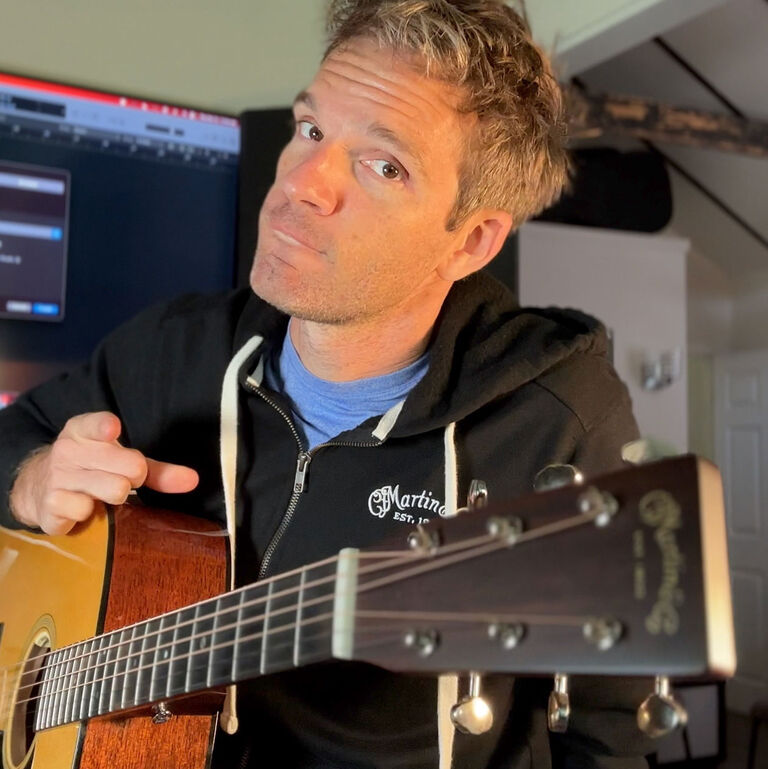
Music now plays a vital role in that creative life. When writing stalls, Robert doesn’t spiral or pace. He picks up a guitar, often one of several Martins that line his space, all chosen with intention.
“The guitar gives me permission to take a break—without feeling like I’ve failed.”
Music occupies a different part of the brain. It allows movement without pressure, creativity without expectation. Writing and music don’t compete for space in his life; they keep one another in balance.
Robert’s guitars reflect both his playing style and his sensibilities. He is drawn to instruments that reward nuance, particularly OM and OMC models that respond to a light touch, and to guitars with history, voice, and lineage. Among them are several Laurence Juber–related models, including an OMC-21 LJ prototype he acquired directly from Juber himself, as well as OMC-44K and OMC-28B LJ.
But one guitar stands apart.

Robert owns a Martin 1-28 built in 1900, an all-original instrument that he keeps in open-G tuning. Small in size but astonishingly loud, it plays with the ease and presence of a much larger guitar. For Robert, it is more than a favorite. It is a portal.
“If I play a piece of music on a 1900 Martin,” he says, “it sounds the way it did 125 years ago.” He pauses, then adds, almost to himself, “What else can I say that about?”
As a novelist who writes about the Gilded Age, the connection is visceral. Nearly everything else from that era—food, cities, sounds, smells—has changed. Music hasn’t. When Robert plays that guitar, he experiences history the same way someone else once did, through vibration and air.

That sense of continuity came rushing forward again while Robert was finishing his most recent novel, Winter in the High Sierra, set in 1899. When his publisher decided to create a theatrical trailer, Robert worried about the soundtrack. It needed to sound period-appropriate, but not antique.
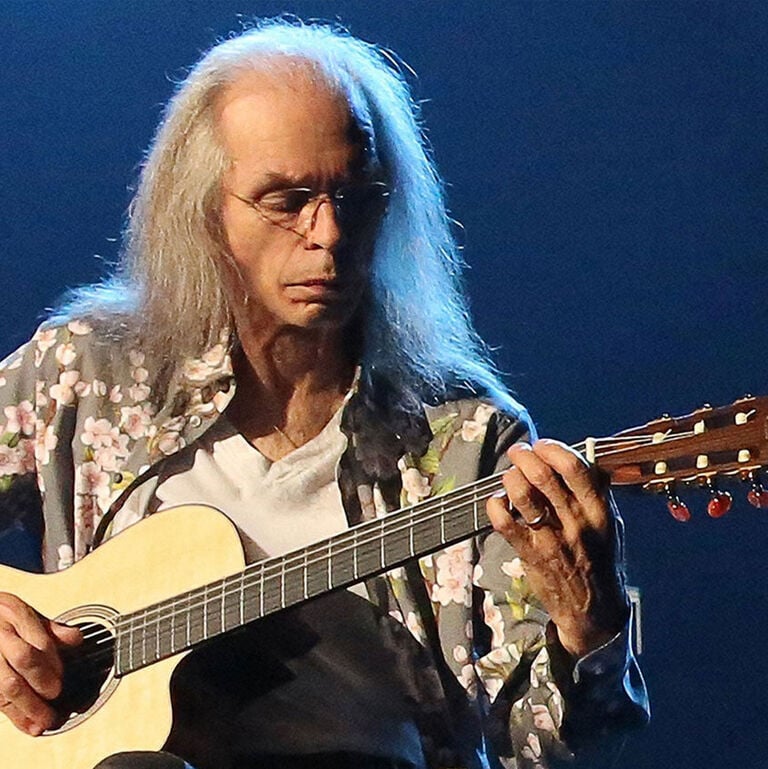
One evening, while playing a favorite piece by Juber, Robert found himself thinking about Juber’s own 1893 Martin 1-21, an instrument that would have already been entertaining audiences for six years before Robert’s story begins. On a whim, he reached out to ask if Juber might consider playing something for the trailer.
Juber didn’t just agree. He composed an entirely new piece—"Snowbound©”—performed on that 1893 Martin 1-21 and inspired by the book itself.
When Robert heard it for the first time, paired with the images from the trailer, the response surprised him.
“I cried,” he says. “I don’t cry a lot… but I heard that thing and I just wept.”
The moment changed how he thought about guitars forever, not just as instruments, but as storytellers. Readers can hear Juber’s composition “Snowbound”, performed on his 1893 Martin 1-21 and featured over the trailer for Winter in the High Sierra, here.
Since then, Robert has begun composing music of his own, chasing the same feeling he knows from writing: imagining something that doesn’t yet exist, then bringing it into the world.
Some of Robert’s most meaningful musical moments weren’t solitary. He often played with his brother-in-law, sharing songs, laughter, and simple joy. Those memories remain vivid, especially now.
“Music’s like smell—it activates your memory center.”
A single note can summon a person, a room, a time. The guitar holds those things safely.
Robert is quick to push back against the idea that talent determines who gets to make art.
“It’s supposed to be hard,” he says. “But it’s also joyous.”
Progress comes quietly. Practice accumulates invisibly. Feeling arrives when thinking steps aside. His father’s advice still echoes through everything he does: “Whenever you want to say ‘I can’t’…add two letters—‘R’ and ‘Y’.”
“I can try.”

Still, what fascinates him most hasn’t changed. All of Western music, he marvels, comes from just twelve notes. Centuries of songs. Endless variation. No exhaustion of possibility.
“Contained in every guitar,” he says, “is a universe of possibility.”
It’s the same instinct that once stood up in a first-grade classroom and imagined a guitar into existence—long before one ever rested in his hands.
Readers interested in exploring more of Robert’s novels and writing can visit his website at https://robertbrightonauthor.com/.
Snowbound© 2025 by Juber Music (ASCAP)