Member Spotlight | March 18, 2026
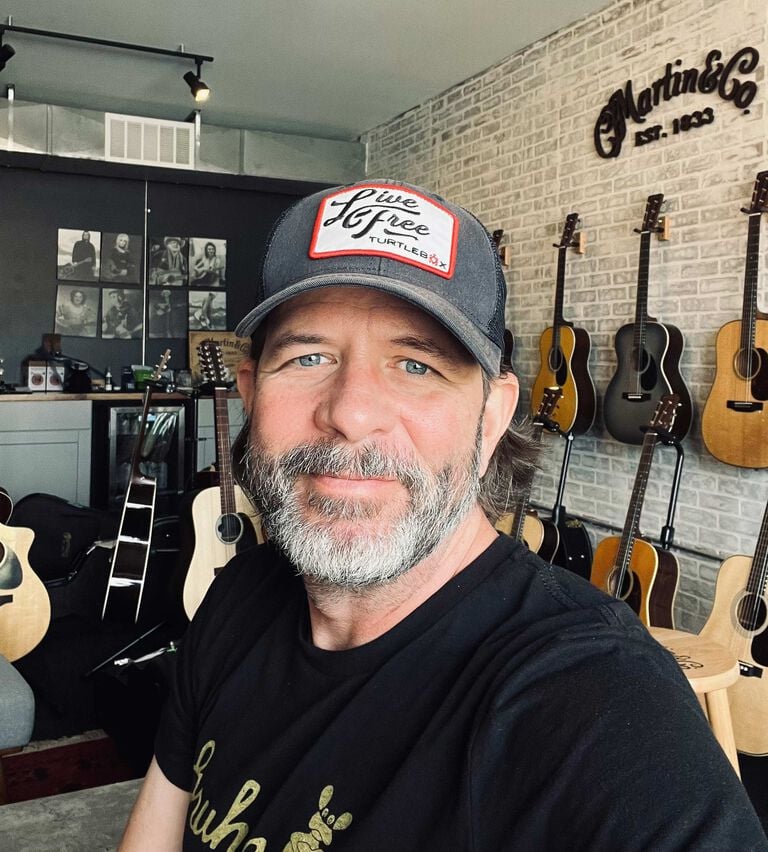
Kevin Dockery Built a Guitar Called “Pappy”
A late start at 55, a D-18 named Angel, and the Backstage wood-picking moment that led to a custom guitar built for family.

Kevin Dockery still remembers holding his first acoustic guitar.
He was a kid in the mid-’70s, roaming through his parents’ room, when he spotted something unfamiliar tucked away. An acoustic guitar—dusty, a string or two missing—resting in the same space where his dad kept tennis rackets hanging neatly on the wall. He didn’t know chords. He didn’t know brands. He just knew the way it felt: the curve of the body, the ring of the rosette around the soundhole, the quiet thrill of making sound with his own hands. In his mind, the strings on the guitar and the strings on a tennis racket lived in the same universe, something you could brush your fingers across and feel the vibration answer back.

Kevin was born in Kingsport, Tennessee, and music was always nearby—fiddles and guitars in the wider family, a father who owned a guitar even if it didn’t come out often. When Kevin was about seven, his family relocated to Gettysburg, Pennsylvania, and he grew up with the kind of motion that builds grit: school, sports, and the steady discipline of learning instruments that demanded focus. He played in drum and bugle corps, then moved into brass, and piano lessons were part of the household rhythm too. His mother believed good instruments and good instruction mattered. If you were going to do the work, you might as well do it with tools worth picking up.
Decades later, Kevin’s life looks like a lot of adult lives—full of responsibilities and schedules—now on a quiet stretch outside Greensboro, North Carolina. Beneath all of it, music never left his life. And then, in early summer 2024, a thought landed with unusual clarity: what if he finally tried guitar?
He was 55 when he decided to learn.
It wasn’t a grand announcement. It was a private question he had to answer honestly. Could he do this now? Could his hands catch up to what his ears loved? He started where most people start: by going to try guitars, thinking he’d ease in with something modest until he proved to himself he’d stick with it.
Then he played a D-18.

Kevin describes it simply: it was “worlds apart.” Not just louder, not just nicer—something fundamentally different in the way the sound sat in the air and in his body. And then the perfectionist part of him kicked in. The top had bearclaw figuring—two marks that, at first glance, felt like flaws he wasn’t sure he could live with. But the longer he looked, the more those marks stopped reading as imperfections and started reading as meaning. To him, they looked like wings.
That’s how his D-18 became Angel.
Kevin names his guitars the way some people name boats or old cars—not to be cute, but because it’s how he relates to things that carry stories. Angel wasn’t just the first serious guitar he bought. It was the first guitar that made him want to pick it up again the next day. And for a new player, that may be the most important spec of all.
The early months were not romantic. Kevin’s fingers hurt—badly. There were days he genuinely wondered if he’d be able to keep going. He calls his hands “office hands,” the kind that can work hard around a home but don’t come pre-loaded with calluses. His breakthrough came in a very beginner-friendly form: he made the guitar easier to play. Switching to a lighter set of strings helped him transition from constant pain to the kind of discomfort that slowly becomes strength. Calluses built. Confidence followed. “Where the mind goes, the body will follow,” he likes to say, and it’s a belief he recognizes from years of soccer—showing up to training, building strength slowly, letting repetition turn into skill. He didn’t wait to feel ready. He kept showing up.
By then, guitar had started to rearrange his days. Kevin and his wife Sonia are empty nesters now, and in his house there’s almost always a guitar within reach—an instrument leaning nearby like a quiet invitation. On a typical day, he’ll put in a solid half hour of playing time, sometimes more, the kind of steady practice that doesn’t look dramatic but changes you over months. Weekends are where he goes deeper, carving out longer sessions and working through chord transitions, fingerstyle patterns, and the mental work of listening closely.
Discipline began through Martin Backstage All Access. Joining opened the door to structured learning in the Martin Lesson Room and then into the broader course catalog on the TrueFire platform. For Kevin, it was a way to build fundamentals and momentum on his own time—enough to get his hands moving and his ears sharper—before he ever sat down with an instructor.

Like a lot of self-taught players, he eventually hit a familiar wall: the plateau that comes when you’re practicing alone in a room. You can make real progress that way, but there’s something you don’t get without feedback—the small corrections, the encouragement that’s earned, the honest critique that says, “Yes, that’s right. Now do it again.” In December, he made a shift. He sought out in-person instruction and found a teacher at the School of Rock who could meet him where he was and keep him moving.
And then Kevin did something else he’d never done.
He sang.
It happened recently—his first time singing while playing, working through “Folsom Prison Blues.” He’s drawn to deeper-voiced songs and gravitates toward country and bluegrass as a home base. That choice is a lesson he’d pass to any new guitarist: you can love everything, but you can’t learn everything at once. He picked a lane and stayed there long enough to build muscle memory. The goal wasn’t to shrink his taste. It was to build a foundation.

As his playing grew, so did his curiosity about sound. After Angel the D-18, Kevin added another Martin to his circle: a D-28 in September 2024 in an Ambertone finish—rosewood-backed, and chosen in part to hear what that tonewood would teach him. He enjoyed it, and it helped him understand tonewoods in a practical way—what he felt under his fingers, what he heard after a chord. But there’s one detail he says with a grin: the D-28 is the only one he hasn’t named yet. It’s still waiting.
His other guitars came with names right away. There’s a D-17 he calls Boomer, because it does exactly what the name promises. And in early 2025, he brought home a smaller-bodied 012-28 Modern Deluxe, a guitar he calls Baby. The reason is tender and completely practical: Kevin wanted a guitar he could play for the next generation—especially now, with his son Jacob starting a family of his own and a grandchild on the way. Dreadnoughts are powerful, but they’re not exactly built for rocking an infant to sleep. Baby, with its soothing fingerstyle comfort, is Kevin’s way of getting ready for those quiet family moments he’s been looking forward to.

Kevin met his wife, Sonia, as a teenager in Pennsylvania in the kind of scene you can picture without knowing the name of the place: a diner after midnight, the end of a night out, the casual bravery of walking over and introducing yourself. Sonia is also Kevin’s living connection to Martin Guitar. Her family has deep roots in the Lehigh Valley, and both her father, Carl, and her grandfather, Harvey, worked at the factory. That lineage isn’t just a fun detail. It’s a thread Kevin wanted to honor in wood and craft—something he could hold, play, and eventually pass down.

So he started researching how a custom build works. He read, studied the build sheets, and slowly translated feeling into decisions. Mahogany was non-negotiable; Angel had already taught him what that voice did for him. Then he began layering in the kind of choices that turn a guitar into a once-in-a-lifetime object: details that reflected his interest in family history, and a Tree of Life motif that felt like a natural emblem for what he was trying to do.
He worked with a longtime local music shop and its owner, Tommy, and together they pulled in Martin Custom Shop support to refine the plan. Kevin saved for it, and because the build was so personal, he didn’t rush the decisions. He let the choices unfold over time—living with them, learning what mattered most, and even realizing that the 12-fret feel he loved on his 012-28 Modern Deluxe was exactly what he wanted to carry into his custom.

In May 2025, Kevin and Sonia traveled up for Backstage at Nazareth to choose the wood.
What should’ve been a simple, behind-the-scenes highlight turned into something the building seemed to improvise in real time. A powerful thunderstorm had rolled through, and when Kevin and Sonia stepped into the lobby, everyone was gathered close—talking, laughing, and then, almost naturally, live music started up right there. The power was out, the space dim, but the mood stayed bright. Even in the aftermath of the storm, they were told they could still choose their wood.
So they chose wood by natural light.
They went into the Custom Shop offices and held tops and backs near windows, studying grain the way you study a photograph you want to remember. Kevin had a dream the night before the event—he doesn’t often dream about guitars—but in the dream he was tapping on wood, not understanding why. The next day, standing there with Sonia, he found himself asking if he could do exactly that. Tap the spruce. Listen. Let his hands confirm what his eyes were drawn to. No one blinked. They tapped along with him. It was normal. The dream and the moment snapped together in a way that felt almost too perfect.

When the custom guitar arrived in mid-December 2025, Kevin did what a careful owner does: he let it acclimate. Then he opened the case with Sonia there. Photographs. Quiet awe. That first strum that feels like both a payoff and a beginning.
And then came the final name.
Pappy.

If Angel was the guitar that chose him, Pappy is the guitar he chose with intention—for family, for legacy. It carries Carl and Harvey in spirit. It carries the patience of learning something new at 55. It carries the lesson Kevin keeps returning to: you don’t have to start early to start sincerely.

For new guitarists, Kevin’s journey offers a simple, durable set of truths. Buy the guitar that makes you want to play. Make the early days easier on your hands so you can stay consistent. Practice small, daily. Find feedback and community before you’re stuck. And when the instrument shows you a mark you didn’t expect—bearclaw on a top, a knot in a piece of wood, a little reminder that life isn’t polished—consider the possibility that it’s not a flaw at all.
Sometimes it’s wings. Sometimes it’s a story waiting to be named.