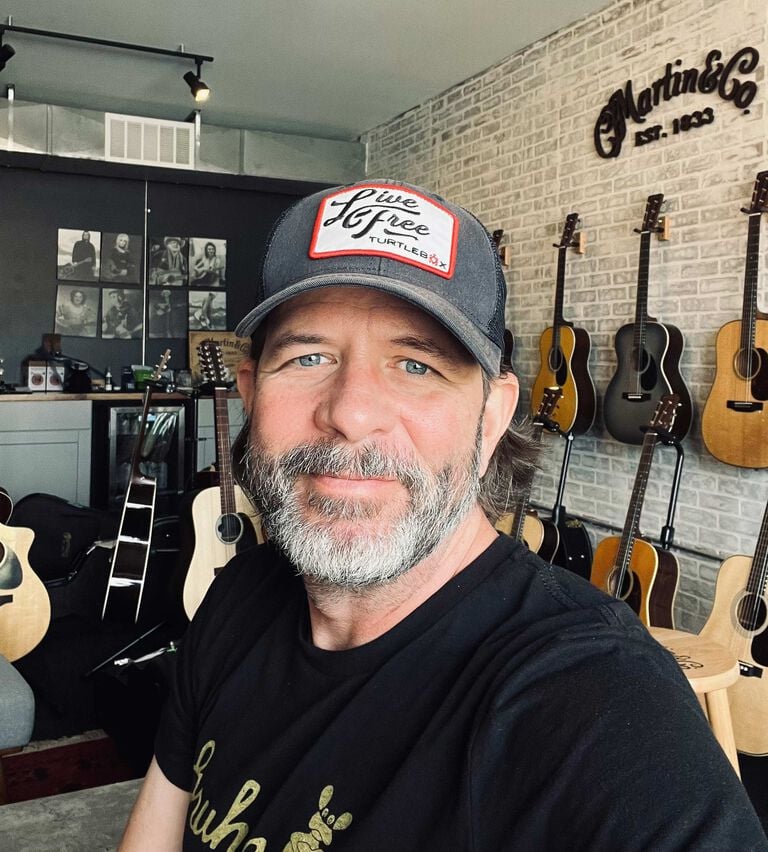
Member Spotlight | April 15, 2026
Matthew Peskay on Learning to Play—and Passing It On
From a summer camp guitar to teaching veterans and modeling daily practice at home, his journey has come full circle

The guitar was already in the room when Matthew Peskay worked up the courage to ask.
It was summer camp in Wisconsin. A cabin full of kids. One of them—a “cool kid,” the kind who seemed to move a little more confidently than everyone else—had brought an electric guitar.
Matthew wasn’t one of the cool kids. But he was curious.
So, he asked.
Without hesitation, the kid handed the guitar over and showed Matthew how to play a simple riff—Eric Clapton’s “Wonderful Tonight.” Sitting on the floor of that cabin, watching where to place his fingers, Matthew played it through.
For the rest of that week, every chance he got, he picked up that guitar and played the same riff again and again. And for years after, it was one of the only things he knew how to play. But he kept coming back to it.
That moment—being handed a guitar by someone who didn’t have to, being shown something without judgment—stayed with him.
It still does.

Matthew grew up in Minnesota, surrounded by music long before he ever learned how to make it himself. His dad listened to Bob Dylan and Paul Simon. He remembers going to a Dylan concert at the Minnesota State Fair. Piano lessons came first—his mom made sure of it. But guitar was something he wanted for himself.
In college, that early spark finally had room to grow. Friends taught him chords, showed him how to play Dylan songs, and—maybe most importantly—let him play along. When he came home one summer, his dad took him to the Homestead Pickin’ Parlor in Minneapolis to buy his first guitar.
Matthew didn’t know anything about brands or tonewoods. But his dad did.
His dad recognized the name. Martin was the brand—the one people spoke about with a certain respect—and that stuck with him.
The shop leaned heavily toward Martins, and a Sigma felt like a more approachable way in. Matthew left with a Sigma DM-1—“Made by Martin”—and played it constantly for the next few years. Dylan, The Beatles, Dave Matthews. Songs that told stories. Songs that gave him something to reach for.
Eventually, he saved enough to trade up. The shop had an upgrade policy—90 percent of the original value toward a new guitar—and Matthew used it to bring home a 1998 Martin DM.
That guitar would stay with him for the next 25 years.
It followed him to New York City, where it became part of his everyday life. It rode the subway in a gig bag. It leaned against apartment walls. It came out whenever there was time, or company, or both.
One night, it ended up in a recording studio.
A friend invited him to sit in with a full band—real musicians, the kind who could carry a song no matter what was happening around them. He wasn’t the most experienced player in the room, but they made space for him—and he stepped right in.
They started playing. “I think we played some Beatles songs… probably some others.” Songs moved from one to the next, carried by the band. At some point, Matthew looked down and saw blood on the guitar.
It took him a second to realize it was his.
He’d been strumming so hard that the skin on his picking hand had torn open. But the band was still going. So, he kept playing.
There was no decision to make. Just momentum. Music. The feeling of being part of something bigger than his own ability.
“I felt such belonging in that moment.”

That feeling would show up again later—in New Orleans, visiting friends after college. Nights that turned into living room jam sessions, where instruments were scattered everywhere—guitars, drums, tambourines, pianos. You didn’t need to be the best. You just needed to join in.
“There are enough good people in the room that can carry it.”
For Matthew, those moments defined what music could be: not performance, but participation. Not perfection, but connection.
And then, like it does, life shifted.
Career. Marriage. A move to Los Angeles. The Martin DM came along, but it spent more and more time in its case. Years passed. Playing became occasional. Eventually, it faded into the background.
It wasn’t until the pandemic—when his daughter was five—that the guitar came back out for good.

He left it on a stand instead of in its case. Within reach. Visible. Easy to pick up for a few minutes at a time.
That small decision changed everything.
What started as a few chords while walking by turned into a daily habit. Five minutes became ten. Ten became thirty.
As he returned to playing more consistently, he also began thinking about his next guitar. After years with his Martin DM, he started exploring what else was out there—trying different OM and 000 models, learning more about tonewoods and feel. Eventually, he found a used OM-28 Modern Deluxe and brought it home. The sound was everything he had hoped for—rich, balanced, alive in his hands. But over time, he realized the feel wasn’t quite right for him—it became pretty challenging to play higher up the fretboard. After a year of going back and forth, he let it go, continuing the search for the next Martin that would truly fit.

Matthew also began to think differently about what it meant to learn.
Online, he found structure through Tony Polecastro’s Acoustic Challenge—lessons, routines, and a simple idea that stuck: compare yourself only to who you were yesterday.
He joined online communities. Started recording himself. At first, just for his own progress. Then, slowly, sharing those recordings with others.
In many ways, that took a different kind of growth than learning the songs themselves.
Hitting “record” brought a different kind of pressure. Mistakes that never mattered before suddenly felt louder. More final. He’d start over—again and again—but over time, he learned to play through the imperfections and keep going.
Posting those videos became something more than practice. It became a record. A way to see growth.
“I started thinking about what I’m going to leave behind… and that these videos are going to be one of the only things people can see of me.”
Months later, his sister said something that stuck.
“You’ve gone from someone learning guitar to someone playing guitar.”
It was a small shift in language. But a big one in meaning.
Not that he had arrived—but that he belonged, and that he had something real to contribute.

That same sense of belonging has come full circle in another way.
About six months ago, Matthew started volunteering with Guitars 4 Vets (G4V), teaching veterans how to play. At first, he hesitated. He questioned whether he was qualified—whether he had enough to offer—but the more he showed up, the more he realized he did.
And in doing so, he found something familiar: the same dynamic from that cabin years ago. One person handing something to another.
“I felt like I had no business teaching… but I got over that.”
He’s since helped students complete the program and receive their own guitars. Watching them learn, struggle, and improve—the same process he’s lived through himself, now with a clearer sense of how far he’s come.
The same process he now models at home.
His daughter, now ten, has grown up watching him play. Watching him practice. Watching him work through frustration and keep going.
It’s not about becoming a professional musician.
It’s about showing what it looks like to commit to something. To learn. To get better over time.
To sit down, even when you don’t feel like it, and pick up the guitar anyway.
Because when he does, everything else falls away.
“When I sit down and play, I don’t think about anything else… my breathing settles.”
Sometimes it’s just five minutes between other responsibilities.
But those five minutes matter.
They add up.
They always have.
Matthew no longer has that 1998 Martin DM. He sold it when the wear and tear felt like more than it was worth to repair.
Now, he’s in between Martins. Looking for the next one. Something that will stay with him for the years ahead.
But the search itself feels familiar.
Because in some ways, it’s the same story.
A guitar. A moment. A decision to pick it up.
And the possibility that comes with it.
Learn More