Member Spotlight | October 15, 2025
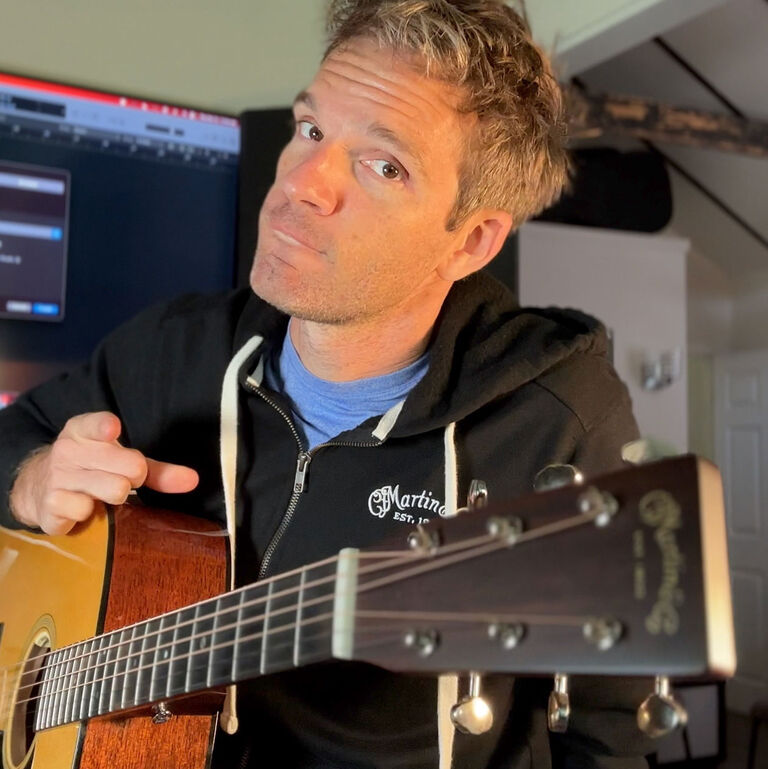
Chris Jude: A Song Still in Progress
From Tokyo and The Beatles to a lifetime with his Martin D-35

On a warm night in Fredericksburg, Texas, Chris Jude sat with a group of musicians at a folk festival, strumming through a song that wasn’t finished. He had the verses and chorus, but the bridge refused to come. A slim man with wire-rimmed glasses paused to listen. “That’s a pretty good song,” he said. When Chris admitted it wasn’t complete, the man replied, “You need to get on that.” Chris laughed it off—until his bandmate whispered: “That was Peter Yarrow.” Within days, the song was done. It was a lesson Chris carried with him: keep going, finish what you start, and remember that songs like “Six Silver Bullets” can grow into something lasting when you give them the chance.
Chris’ journey with music began halfway around the world. As a military child, he moved constantly—four high schools, countless towns. But music gave him something permanent. Stationed in Tokyo in 1964, his mother shook him awake one night to see The Beatles on The Ed Sullivan Show. Ed Sullivan’s voice was dubbed into Japanese; The Beatles sang in English. “I was hooked,” Chris remembers. Soon after, he received a guitar for Christmas and started six months of classical lessons with a patient Japanese teacher. Though he struggled to read music, the fingerpicking exercises laid the foundation for everything that followed.
Even at age 11, Chris wanted to play The Beatles and The Ventures, not scales. By seventh grade, he was playing in a band with friends—covering “Michelle,” and learning the joy of rhythm guitar. When the band dissolved as military families moved, Chris leaned inward. “I almost became just a solo guy, playing for myself, playing for my friends. But I almost always played my own music,” he says. With his own songs, he was confident, “I knew all the words, I knew all the chords." He didn’t worry about mismatched expectations, and covers left him vulnerable to comparison.

By 1980, Chris’ musical life intersected with Martin Guitar. On sabbatical from his professional career, he bought a D-28 while studying recording at Full Sail University in Orlando. “It recorded beautifully. It had the sound I wanted, and it was the guitar Neil Young and Stephen Stills played,” he recalls. A decade later, he traded it for a D-35, the guitar that became his truest companion. “Almost every song I’ve written in the last 35 years has been on the D-35. That guitar knows all my secrets.”

The D-35’s deep bottom end anchored countless bands and living room performances. Chris later added a D-41 on consignment, and over time, a small stable of Martins: a custom maple GPCPA, a 000-18 (later traded in for a 000-28), a CEO-7, and a TK1 ukulele. Each guitar had its voice, but the D-35 remained the heart of his songwriting. Even after repairs and upgrades, it continues to guide him. “Sometimes I wonder if the guitar isn’t my conscience. It just somehow knows when I’m not saying or playing the right things.”

While music remained a passion, Chris built a career as an avionics engineer for Northrop Grumman and later Lockheed Martin, working around the world, even training the Royal Saudi Air Force. Music became his creative balance. “The guitar has always been my way to balance out the professional engineering side and my creative side,” he explains. On business trips, he packed a travel guitar. On a recent river cruise through Europe, his playing sparked impromptu singalongs on the top deck, drawing strangers into community through song. “It’s not only been personal,” he says, “it’s been a way to connect with people.”

Reflecting on decades of playing, Chris is candid about his growth. He cites Johnny Cash’s line that “style is what you develop when you don’t have enough talent to have technique.” For Chris, style emerged from limits, but also from honesty. He recalls one night in Austin when legendary bassist Tommy Shannon sat in with his band. Shannon played flawlessly, instinctively knowing every change—an example of professional-level skill forged by years of constant playing. Chris, still working full-time as an engineer then, admired that mastery while recognizing his own path would always balance work and music. He is quick to point out that he’s not a professional musician, but rather a passionate songwriter who channels his experiences into original songs. Songs like “Six Silver Bullets” and “Baby Boomer Blues” grew out of personal encounters, family conversations, and everyday life. “I have to have something inside me that needs to come out,” he says. “That’s when the songs arrive.”

Today, living in Hardeeville, South Carolina, Chris performs often in his community. He insists on playing originals, weaving in stories that give each song context. His wife, Nancie, encourages him to share more of the 150 songs in his library. She sees the potential in his catalog, urging him to let others hear what he has created. His mother once told him after hearing him play “Silent Night,” “You really missed your calling—you should have been a musician.” Chris smiles at the memory. “Where were you when I was 18?”
For Chris, Martins aren’t just instruments; they are vessels of legacy. Owning them, playing them, writing on them connects him to the craft and community of music makers across generations. “It’s not just a guitar I bought in 1990,” he says. “It’s the embodiment of a legacy.”
And through his songs—finished and unfinished—Chris Jude continues to add his own verses to that enduring story. Chris doesn’t typically make his music available online, but he has been so kind to share “Six Silver Bullets”, the song Peter Yarrow encouraged him to finish.