Member Spotlight | December 15, 2025
Mickey Levine: Finding His People in Song Circles
From Fox Hollow and Boston folk to a 000-28 Modern Deluxe in a Sunday ukulele circle

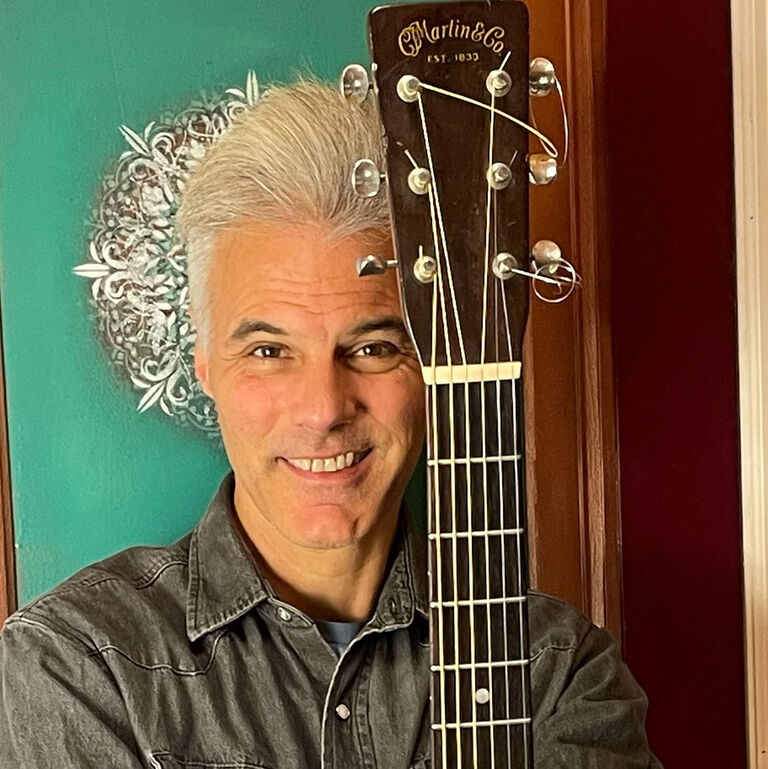
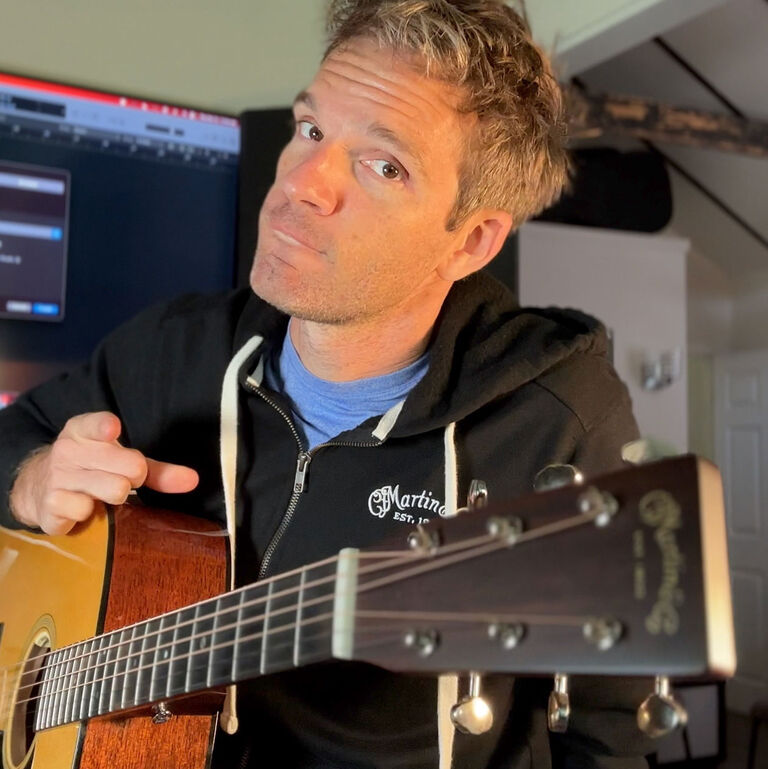
On Sunday afternoons in Washington State, a semicircle of ukulele players fans out in folding chairs, songbooks open. In the middle sits Mickey Levine with his 000-28E Modern Deluxe, anchoring the sound amid a sea of tiny instruments, carrying both rhythm and lead.
“I’m basically the rhythm and lead guy,” he says. While the ukes strum the chords, his guitar adds bass runs, little fills, and the kind of authority that comes from decades of playing. It’s not a big stage, but it’s where Mickey has always felt most at home: in a circle of people making music together.

That circle started in Chicago. Mickey grew up in a house where his father, a Jewish cantor, filled the rooms with liturgical melodies while Frank Sinatra spun on the record player. His two brothers pulled him into the 1960s folk boom; they listened to WFMT’s The Midnight Special, chased touring folksingers, and sat in awe at concerts. Somewhere along the way, folk music stopped being just something on the radio and became the family soundtrack.
One of his earliest live music memories is sitting in the audience for a trio show with Josh White Sr., Bob Gibson, and Jo Mapes at a folk concert. Years later, folk wasn’t just in his ears but in the family tree—one of his brothers married Mapes’ daughter, tying their household even more tightly to that scene. Mapes herself was a well-known Chicago folksinger and jingle writer, remembered in Mickey’s family for the Kellogg’s Raisin Bran commercial she wrote and sang.
Mickey’s first real statement as a player was a Kay banjo. “Everyone else was playing guitar, so I bought a banjo,” he laughs. His mother, an artist, sanded the peghead and inlaid a star so it looked like a Vega. At school, he was a classically trained pianist accompanying choirs, and at camp, he hauled an Epiphone 12-string as the kid who always had a song ready. “Why did I have a 12-string? Well, everybody else had six strings,” he says.
The guitar truly took hold when a family friend lent them a Martin D-28 for about a year. Compared to the Harmony Sovereign in the house, the D-28 felt like stepping into the world of the performers he admired. “That was it,” he says. “That was the sound.” His first Martin purchase was a 00-18G, followed by a D-18 that became his bluegrass workhorse.

In his twenties, Mickey landed in Cambridge, Massachusetts, where musicians gathered on the Common on warm Saturdays to play all day. Surrounded by bluegrass pickers and folk musicians who shared his language of songs and stories, he started to think of them as "his people." In those circles, he crossed paths with a young Béla Fleck, then just a Tufts student with a banjo, and met fiddler Paul Chrisman—later “Woody Paul” of Riders in the Sky. With banjo player Don Borchelt, they formed a trio, roaming New Hampshire fiddle contests and sneaking into the top three more often than not.
The guitar that defined those years was a Martin D-41. Mickey traded his D-18 and some cash to bring it home, and from then on, it was his main voice.

Around that time, he also became a regular accompanist for Boston folksinger Tom Smith, the "Kitchen Musician" whose songs and stories are rooted in old-school folk tradition. Mickey backed him on guitar, banjo, and mandolin at coffeehouses and festivals throughout the Northeast, including that Fox Hollow main-stage set that felt like a turning point. Sharing that stage alongside other respected artists was a powerful validation, confirming they belonged there and helping open the door to more festival and coffeehouse opportunities.

Life, though, has its own timing. Years after moving his family from the East Coast to the Seattle area for work in tech, both he and his wife lost their jobs, and the mortgage didn’t care how good the D-41 sounded. Mickey sold the D-41, his old 1919 Vega banjo, and a Givens mandolin, doing what he had to do to keep the family afloat. For a while, there was nothing in the house to play, and music took a back seat to work and family.
His brother eventually sent him a Yamaha so he’d have something under his fingers again. Even in the Seattle suburbs, he felt far from his bluegrass and folk crowd—his people—and missed the easy access to those circles. He stayed connected to the Folk Song Society of Greater Boston and, years later, flew back east for a Woody Guthrie tribute, “Bound for Glory.” After the show, a close friend asked why he’d never gone fully professional. Mickey just smiled and thanked her for thinking he was that good. In his mind, he’d chosen a life where music and work coexisted, even if that meant the spotlight was smaller.
The most emotional full-circle moment came around his 70th birthday. Leafing through a Sweetwater catalog with his wife, she asked which guitar he’d choose if he could. He pointed to one he never expected to own: a 000-28 Modern Deluxe—the one on the right, with the electronics built in. Then he turned the page and moved on.
Quietly, his wife brought the selection to his daughter and they started saving. On his birthday, his daughter walked in carrying a case. Inside was the 000-28 Modern Deluxe, complete with electronics.
“I opened it up and thought, ‘You didn’t do this,’” he says. “And they had.” He did what every player does: formed a four-finger G chord and strummed. The guitar answered with that unmistakable Martin warmth, balanced and clear, easier on the hands than a big Dreadnought but still full of authority. After years of making the hard choice to sell his dream guitar, his family had put a new one back in his hands.
These days, the 000-28E Modern Deluxe is the guitar Mickey brings to his ukulele circle with the Eastside Ukulele Players Association (ESUPA). That loose-knit orchestra of players gave him back some of what he’d lost when he left Boston—a local circle of kindred spirits, even if most of them play four strings instead of six. He loves seeing beginners show up with whatever they can afford, but he worries when an instrument is so poorly set up that it almost guarantees frustration. His advice is simple: practice, of course—but also give yourself an instrument you don’t have to fight, play songs you actually love, and find other people to play with. “You learn faster when you’re not alone,” he says.
If you zoom out on his story, the constant isn’t the stage or the set list. It’s the circle: Chicago folk shows with his brothers, Cambridge jam sessions with future legends, Guthrie tributes in Boston, and now Sunday afternoons in Washington with a ukulele group humming around the bell-like ring of a Martin. The loaner D-28 showed him what was possible, the D-41 carried him through his hungriest years, and the 000-28E Modern Deluxe marks a gentler kind of arrival—a life where the real reward is the people who end up singing beside you.
If you’d like to experience a bit of Mickey’s world for yourself, you can explore two of the communities that mean a lot to him:
- The Eastside Ukulele Players Association (ESUPA) in Washington, where players of all levels come together to learn, strum, and sing.
- The "Bound for Glory" Woody Guthrie tribute concert series from the Folk Song Society of Greater Boston