From the Factory, History | May 13, 2026
The Martin Ukulele That Flew Over the North Pole 100 Years Ago
Richard Konter's 1926 Style 1K Ukulele, The Byrd Expedition, And the Journey of a Lifetime.

Some instruments tell stories.
And then there are instruments like this—ones that don’t just make history, but go along for the ride.
Inside the Martin Museum in Nazareth, Pennsylvania, there’s a small soprano ukulele that has been farther than most instruments could ever dream of going. Nearly 100 years ago to the day—on May 9, 1926—it flew over the North Pole.
Not metaphorically. Not symbolically.
Literally.

A Sailor, A Songwriter, And A Plan
Richard “Ukulele Dick” Konter wasn’t just a musician—he was a U.S. Navy radioman, a seasoned seafarer, and a prolific ukulele composer. Music was part of who he was, wherever he went.
“So Richard Konter was in the United States Navy, and he was also a well-known ukulele composer from Brooklyn,” says Martin Museum and Archives Manager Jason Ahner. “And in 1926, Konter volunteered to go with Admiral Byrd on the first expedition to the North Pole.”
Before setting out, Konter picked up a brand-new Martin Style 1K soprano ukulele—an all-koa instrument that, at the time, reflected just how popular ukuleles had become in America.
His goal was simple: bring it along as a keepsake.
What happened next was anything but.

Smuggling A Ukulele Into History
The expedition traveled north by ship, carrying with it an airplane that would attempt the historic flight over the pole. Somewhere along the way, Konter struck up a friendship with the expedition’s pilot, Floyd Bennett.
That friendship changed everything.
“He becomes friends with Floyd Bennett,” Jason explains. “And he was like, ‘Hey, I want a souvenir. Can you smuggle my uke on the plane?’”
There was just one problem: strict weight limits.
But the ukulele? Practically weightless.
“Bennett was like… yeah, this thing weighs next to nothing. I’ll just stick it under my seat.”
And just like that, Konter’s Martin 1K—along with a Hohner harmonica tied to its neck—was tucked into the aircraft among stacks of furs.
On May 9, 1926, it became part of the first flight over the North Pole.

Back On Deck—And Covered In Signatures
When Bennett and Admiral Richard Byrd returned safely, the ukulele was handed back to Konter.
That could have been the end of the story.
Instead, it became the beginning of something even bigger.
Konter started collecting signatures—first from the expedition crew, then from anyone he encountered along the way. He even added notes directly onto the instrument, marking moments in time.
Then came Washington, DC.
At a reception at the White House, Konter brought the ukulele along.
“And so at the reception, he has [President] Calvin Coolidge sign it, Thomas Edison, Charles Lindbergh, Amelia Earhart… all of these dignitaries at the time,” Jason says.
Over time, more than 150 signatures would find their way onto its koa surface.
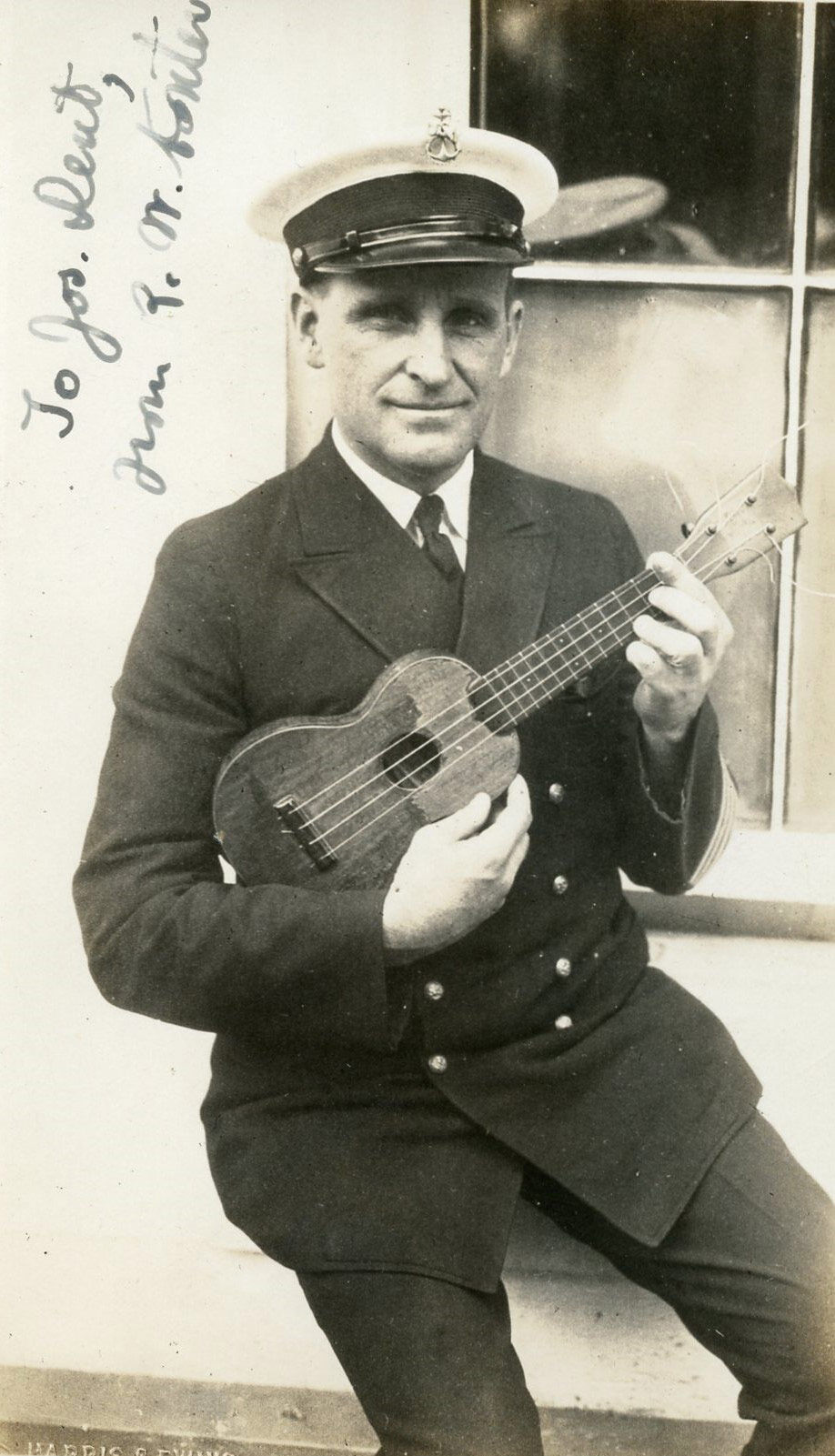
Richard “Ukulele Dick” Konter outside the White House with his Martin Style 1K ukulele, shortly after the 1926 North Pole expedition—where it was signed by President Calvin Coolidge and other notable figures.
A Who’s Who Of American History
It’s one thing for an instrument to travel somewhere remarkable.
It’s another for it to carry the names of the people shaping that era.
“When I give a museum tour, I usually say it’s our most historically significant instrument because of where it’s been, who signed it,” Jason says.
And those names?
“Thomas Edison, Calvin Coolidge, Charles Lindbergh, Amelia Earhart, and John Pershing, just to name a few.”
Think about that for a second.
This single ukulele connects:
- The early days of aviation
- The White House in the 1920s
- Some of the most influential figures in science, exploration, and American history
All through one instrument.

Why A Ukulele? Why Then?
To understand why Konter brought a ukulele in the first place, you have to zoom out and look at the moment.
The 1920s weren’t just the Jazz Age—they were the golden age of the ukulele.
“Well yeah… mid-’20s, Martin was building three times as many ukuleles as guitars,” Jason explains. “They were huge for the company.”
Demand was so high that Martin expanded its North Street factory multiple times just to keep up.
“A big reason why Martin was able to survive the Great Depression was the cash reserves they had built up from ukulele sales.”
In other words, this wasn’t a novelty instrument tagging along on an expedition.
It was the instrument of the moment.

A Journey That Didn’t End At The Pole
Konter didn’t stop with the Arctic.
He later brought the same ukulele along on the first expedition to the South Pole, adding another chapter to its already unbelievable story.
By then, the instrument had become more than a souvenir.
It was a companion. A document. A time capsule.

Finding Its Way Home
Eventually, Konter decided the ukulele belonged somewhere permanent.
“That one was sent to the company by Konter,” Jason says. “He wrote a letter, I think it was in 1952… explaining where the ukulele had been… and then traded it for a D-28.”
That letter (below) still exists in the Martin archives—a firsthand account of the instrument’s journey.
And with that, the ukulele returned home to Nazareth, where it remains today.

Richard Konter’s 1952 letter to Martin, detailing the remarkable journey of his Style 1K ukulele—and arranging its return to Nazareth in exchange for a D-28.
A Story Recreated
The story of Konter’s ukulele didn’t just stay in the past.
Martin’s Custom Shop brought it back to life with a special recreation of his Style 1K. Every detail—from the all-koa construction to the placement of the signatures—was carefully studied and reproduced.
“But to have all of the signatures on it… we did the project a few years ago where we were building them through our Custom Shop, and all of the signatures were laser engraved,” Jason says.
The result was the now-retired Konter Uke—a replica that made those historic signatures easier to see and appreciate, while preserving the spirit of the original instrument.
The project was accompanied by a book by Larry Bartram and Martin’s own Dick Boak, A Stowaway Ukulele Revealed: Richard Konter & The Byrd Polar Expeditions, which dives deeper into the people behind the names—and the story behind each signature.

Over 100 Years Later
A century since a small Martin ukulele slipped onto a plane, crossed the top of the world, and came back with a story no one could have predicted.
Today, it sits quietly behind glass in Nazareth.
But look a little closer, and you’ll see it for what it really is:
A stowaway.
A witness.
A piece of history you can still stand in front of.

See It For Yourself In Nazareth
Richard Konter’s 1926 Style 1K ukulele is currently on display at the Martin Museum in Nazareth, Pennsylvania.
And like many of the instruments in the collection, it tells a story that goes far beyond its size.
It’s a ukulele, yes.
But it’s also a passport stamped by history—signed by the people who shaped it.

More From the Martin Museum
Explore other legendary Martin guitars on display, including:
- Joan Baez’s 1880 0-40
- Johnny Cash’s D-42
- Eric Clapton’s 000-28EC prototype
- Kurt Cobain and Elliott Smith’s 1953 D-18
- Judy Collins’ 1971 D12-35
- Leo Fender’s earliest electric guitar test
- Waylon Jennings’ 1946 D-28
- John Mayer’s original OM-28JM prototype
- Motörhead’s (smashed) DC-16WE
- Les Paul’s first “good” guitar
- Babe Ruth and Lou Gehrig’s signed 00-18
- James Taylor’s 1937 D-18
- Hank Williams’ 1947 D-18
Stay tuned for more stories behind the strings—only at the Martin Museum.
Until next time, happy playing!


