From the Factory, History | June 10, 2026
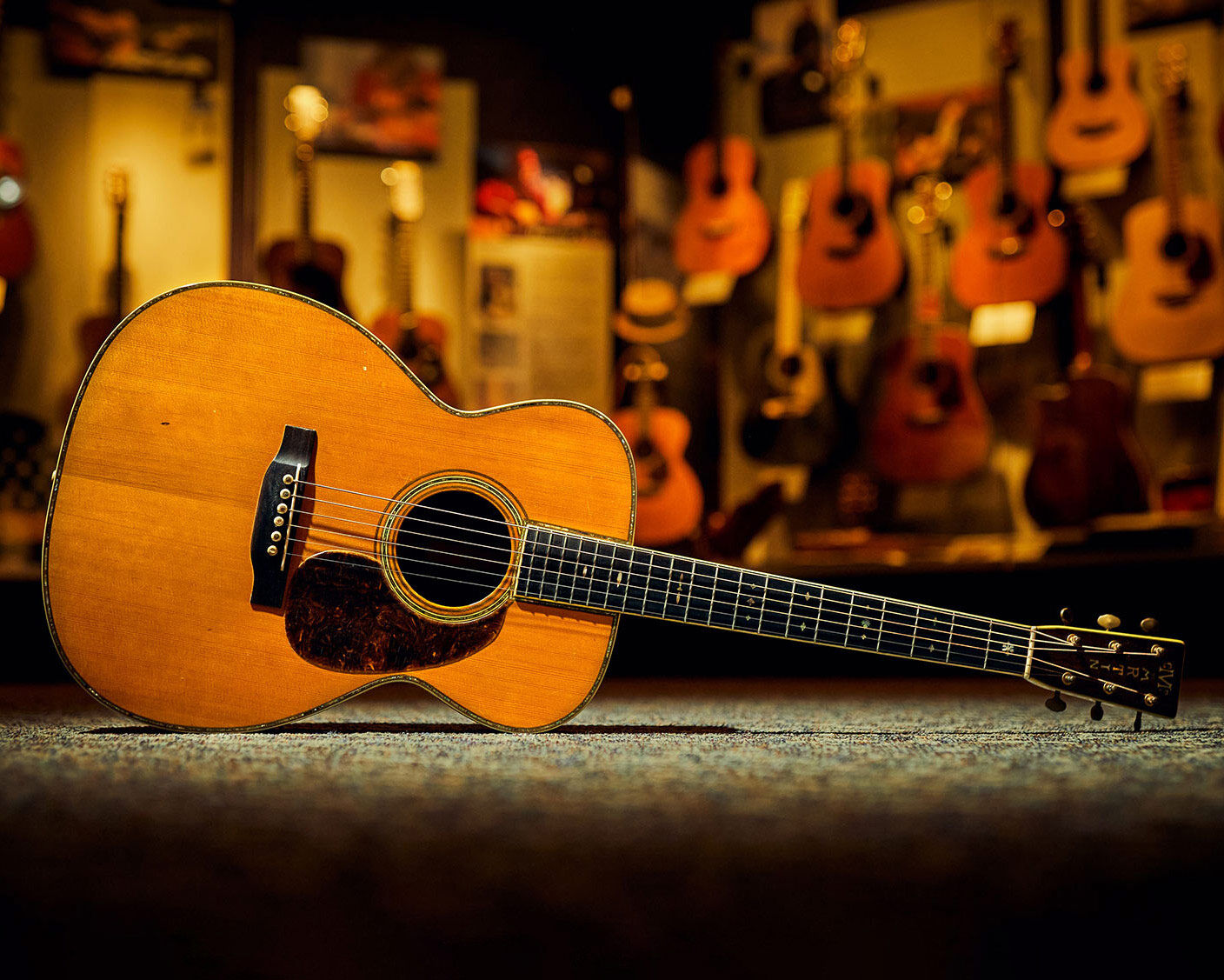
The 1933 Martin OM-45 That Went to War
John DeGrote’s rare pre-war Martin OM-45 landed at Normandy Beach, traveled through Europe during World War II, and now lives behind glass in the Martin Museum.

Some guitars are rare because of how few were made.
Others are rare because of where they’ve been.
John DeGrote’s 1933 Martin OM-45 is both.
Only 40 OM-45s were built from the time the model was introduced in 1930 until it was discontinued in 1933, making any pre-war OM-45 a remarkable piece of Martin history. But this one carries a story that goes far beyond its pearl inlay, long scale, and Orchestra Model size.
It landed at Normandy Beach.
Not on D-Day itself, but not long after, when DeGrote brought it with him while serving in the United States Army during World War II. From there, the guitar traveled across Europe in his radio dispatch truck, becoming a source of music, comfort, and connection wherever he stopped.
Today, it’s on display in the Martin Museum in Nazareth, Pennsylvania—proof that a great guitar can do more than survive history.
Sometimes, it carries it.
A Rare Martin Before The War
Before this OM-45 ever crossed the Atlantic, it was already something special.
The OM—or Orchestra Model—was still a relatively new idea in the early 1930s. The first OM was built for banjoist-turned-guitarist Perry Bechtel in 1929 and entered Martin’s records as a 000-28 Special. Soon after, the OM became one of Martin’s most important early 14-fret designs, combining a comfortable body size with the projection and response of a longer scale.
But the original OM era didn’t last long.
“Early on, OMs were pretty short-lived,” says Martin Museum and Archives Manager Jason Ahner. “The first OM was the Perry Bechtel OM-28, which is listed in our records as a 000-28 Special. That was in 1929. By 1934, OMs were discontinued because Martin had updated the 000s.”
For a brief window, the OM and 000 were closely related, especially as Martin began shifting 000 models to 14-fret designs. Eventually, the defining difference came down largely to scale length, with OMs keeping the longer scale and 000s later moving to a shorter scale.
“For a while, a 000-28 and an OM-28 would have been basically the same guitar,” Jason says. “Then later in 1934, Martin changed the 000s from long scale to short scale. So it was a pretty brief period—you’re talking about four or five years where OMs were being built. There just aren’t many from that era.”
And then there’s the OM-45.
Style 45 represented the top of Martin’s catalog—pearl-trimmed, elegant, and built with the finest materials of its day. With only 40 OM-45s built between 1930 and 1933, John DeGrote’s guitar was already an exceptionally rare Martin before its most remarkable chapter even began.

John DeGrote And His OM-45
John W. DeGrote was born in rural Ridott, Illinois, in 1921. He started playing music at an early age and went on to become an avid and skillful guitarist and bassist, primarily playing bluegrass and country throughout northern Illinois, southern Wisconsin, and later Tennessee.
At some point, DeGrote acquired this 1933 OM-45. Jason believes he may have purchased it used.
“You figure it’s a 1933 guitar, and D-Day was in 1944,” Jason says. “He was pretty young at the time, so I don’t think he would have been buying what would have been about a $200 guitar in 1933, when he was just 12 years old.”
However it came into his hands, it stayed there.
When DeGrote joined the U.S. Army during World War II, he brought the OM-45 with him.

Landing At Normandy Beach
June 6 recently marked the 82nd anniversary of the Normandy Landings, known around the world as D-Day, when Allied forces launched the massive invasion that helped turn the tide of World War II in Europe. John DeGrote did not land on D-Day with this guitar, but he did land at Normandy Beach afterward during the war—and from there, the two traveled across Europe together.
DeGrote later described the journey in his own words:
“My 1933 Martin OM-45 landed with me, and we spent two years together with Patton’s Third Army in seven countries—through heat, rain, snow, bombings, sniping, strafing. Every chance we got, we entertained fellow GIs. And we both managed to get home in December of ’45 all in one piece.”
That last line says a lot.
A soldier. A guitar. Two years in wartime Europe. Both home in one piece.

Music In The Middle Of War
It’s easy to picture a guitar in a museum case and forget that it was once part of someone’s daily life.
This OM-45 wasn’t just something DeGrote owned. It was something he played. It was something he carried with him through one of the most difficult chapters of the 20th century.
“It’s not like he was in the infantry with it slung over his shoulder,” Jason says. “But still, he was driving through probably the most violent war of all time with this guitar. He took it all over Europe, and wherever he stopped, people wanted to play it.”
That detail is what makes the story so human.
The guitar wasn’t on a battlefield as a symbol. It was in a radio dispatch truck. It was played whenever there was a chance. It entertained fellow GIs. It brought music into places where music was probably needed most.
For DeGrote, it became more than an instrument.
It became a partner.

“My Old Buddy”
After the war, DeGrote returned to Illinois, worked at National Lock in Rockford, and later started DeGrote Radio and Television in Pecatonica. He continued playing music for years, performing in bluegrass and country groups throughout the Midwest and Tennessee.
By the mid-'70s, after decades with the OM-45, he decided it was time to retire it.
“In 1976, after years of playing together in bluegrass bands, I decided it was time to retire my partner,” DeGrote said. “What better place than the Martin Guitar Museum, if Martin felt it deserved space with their other historic instruments. They did.”
According to Jason, Martin acquired the guitar directly from DeGrote.
It eventually made its way back home to Nazareth, where it joined the Martin Museum collection. DeGrote visited it there more than once.
“I’m happy that other Martin lovers can admire my old buddy,” he said. “I’ve visited my beloved OM-45 three times now. It looks, plays and sounds as always, with its beauty and unmatched tone.”
DeGrote passed away in 2017 at the age of 95, but his story—and the story of the guitar he carried through World War II—continues to live on behind glass in the Martin Museum.

Behind the Glass: John DeGrote’s 1933 OM-45
In the Behind the Glass episode below, Jason shares the story behind DeGrote’s OM-45, the brief original history of Martin’s Orchestra Models, and how this pearl-trimmed pre-war guitar survived a journey most instruments were never built to take.
A Testament To Martin Build Quality
When Jason shows people DeGrote’s OM-45 in the museum, there’s one point he always comes back to.
“Whenever I show people the guitar, I say it’s a testimony to the build quality of a Martin,” Jason says. “The fact that a beautiful pearl-inlaid OM-45 survived World War II is pretty incredible.”
Think about that for a second.
A Style 45 Martin from 1933—an ornate, finely crafted acoustic guitar—made it through wartime Europe in a radio dispatch truck. Heat. Rain. Snow. Bombings. Sniping. Strafing. Two years overseas. And then decades of music afterward.
It’s a remarkable story of survival.
But it also speaks to something bigger.
Martin was founded decades before the Civil War. The company was still building instruments through World War I. Through World War II. Through changing musical styles, changing players, changing stages, and changing generations.
DeGrote’s OM-45 is one more reminder of that long, living history.
“It also shows the longevity of the company,” Jason says. “It’s one of those things that really puts the company’s history into perspective.”

The OM’s Second Life
The original OM period may have been brief, but the idea never really disappeared.
Over time, players and builders kept coming back to what made the OM so special: the balanced body size, long-scale power, and responsive feel that made it ideal for fingerstyle players, flatpickers, and anyone who wanted clarity without giving up projection.
“OMs returned in the ’90s,” Jason says, “because there were players who really loved them, like Eric Schoenberg. Martin was building the Schoenberg guitars in the late ’80s and early ’90s, along with special runs and Custom Shop models in the ’70s and ’80s. But OMs didn’t really make a return to the Standard Series until the 1990s.
“And because there’s always that discussion about OMs and 000s, the bodies are the same,” Jason says. “It really comes down to scale length now. For a while, an OM was long scale with a 1 3/4-inch nut width, while a 000 was short scale with a 1 11/16-inch nut width. Today, since many of our guitars use a 1 3/4-inch nut, the main difference is scale length—unless you’re looking at something like John Mayer’s OMJM, which pairs a long scale with a 1 11/16-inch nut.”
Today, the OM remains one of Martin’s most beloved body styles—and the OM-45 is once again part of the Standard Series lineup, reintroduced in 2025 as part of Martin’s Standard Series refresh. Nearly a century after John DeGrote’s guitar was built, the model continues to represent the same blend of elegance, balance, and unmistakable Martin craftsmanship that made the original pre-war OM-45 so special.
DeGrote’s OM-45 comes from the very beginning of that story—a short-lived pre-war era that helped shape what the model would become.

See It For Yourself In Nazareth
John DeGrote’s 1933 OM-45 is currently on display at the Martin Museum in Nazareth, Pennsylvania.
It’s a pre-war Martin. A rare OM-45. A World War II companion. And, in DeGrote’s own words, an “old buddy” that found the perfect place to rest.
It landed at Normandy Beach.
It traveled through Europe.
It entertained fellow GIs.
It came home in one piece.
Now it’s enjoying a well-earned retirement behind glass in Nazareth, where Martin fans can see more than pearl inlay and vintage craftsmanship.
They can see a guitar that went to war, came home, and is still telling one incredible story nearly a century later.
More From The Martin Museum
Explore other legendary Martin instruments on display, including:
- Joan Baez’s 1880 0-40
- Johnny Cash’s D-42
- Eric Clapton’s 000-28EC prototype
- Kurt Cobain and Elliott Smith’s 1953 D-18
- Judy Collins’ 1971 D12-35
- Leo Fender’s earliest electric guitar test
- Waylon Jennings’ 1946 D-28
- Richard Konter’s 1926 Style 1K ukulele
- John Mayer’s original OM-28JM prototype
- Motörhead’s (smashed) DC-16WE
- Les Paul’s first “good” guitar
- Babe Ruth and Lou Gehrig’s signed 00-18
- James Taylor’s 1937 D-18
- Hank Williams’ 1947 D-18
Stay tuned for more stories behind the strings—only at the Martin Museum.
Until next time, happy playing!


