Tips & Tutorials | September 15, 2026
Guitar Slang & Jargon for Beginners: Acoustic Guitar Terms Explained
What’s a Dreadnought? Why is your guitar’s “action” high? And what exactly does it mean when someone says an acoustic sounds “warm”? Consider this your beginner-friendly dictionary of guitar slang, acoustic guitar terminology, and common guitar terms every new player should know.

You’ve decided to learn guitar. Great choice.
Then somebody tells you to check your action, grab a capo, watch your intonation, try a barre chord, and maybe look for a short-scale 000 with a solid spruce top and scalloped X-bracing.
Excuse us?
Like anything that has been around for generations, guitar comes with its own language. Some guitar terminology is technical. Some is shorthand. Some is slang. And some has been repeated by guitar players for so long that everybody forgets there was a time when words like Dreadnought, tonewood, fret buzz, and flatpicking needed an explanation.
If you’re shopping for your first acoustic guitar, taking guitar lessons, watching videos online, or simply talking to other musicians, learning a few of these terms can make everything feel a lot less intimidating.
The good news? You don’t need to study any of this before you play your first chord.
Instead, think of this guitar slang dictionary as the friend you bring along to the guitar shop—the one you can quietly ask, “Okay, what did that mean?”
And the easiest place to start is with the thing sitting right in front of you.
Acoustic Guitar Parts and Basic Guitar Terms
Before we get into playing techniques, tone, gear, and the truly weird guitar slang, let’s make sure we know what we’re actually pointing at.
Acoustic Guitar
An acoustic guitar creates its sound primarily through the vibration of its strings and body rather than depending on an amplifier.
The large hollow body helps turn the relatively small vibration of the strings into the bigger acoustic sound you hear.
Acoustic-Electric Guitar
An acoustic-electric guitar is an acoustic guitar equipped with electronics that let you plug into an amplifier, a venue's sound system (or PA), an audio interface for recording, or other compatible gear.
You can still play it unplugged like a traditional acoustic. The electronics simply give you another option when it’s time to perform or record.
Body
The large hollow section of an acoustic guitar.
Body size and shape affect both how a guitar feels against you and how it sounds and vibrates when you play. If terms like Dreadnought, 00, 000, OM, Grand Performance, and Jumbo already have your head spinning, Martin’s guide to acoustic guitar body sizes and shapes takes a much deeper dive.
Top or Soundboard
The part of an acoustic guitar body that contains the soundhole—the opening beneath the strings—and sits beneath the strings.
You’ll hear both top and soundboard used. When somebody says a guitar has a spruce top, this is the piece they’re talking about.
Back and Sides
Exactly what they sound like: the wood or material forming the back and sides of the guitar body.
This is where terms like mahogany, rosewood, sapele, walnut, and koa start entering the conversation.
And yes, guitar players can talk about wood for an extremely long time.
We are among them.
Neck
The long portion extending from the guitar body toward the end where the strings meet the tuning machines.
Your fretting hand travels along the neck while you play.
Fingerboard or Fretboard
The playing surface on the front of the neck where you press the strings down.
You will hear fingerboard and fretboard used interchangeably.
Frets
The thin metal bars positioned across the fingerboard.
Pressing a string behind a fret changes the vibrating length of the string and produces a different note.
Fret
Also a verb.
“Fret the third fret” simply means press the string down at that position.
Guitar vocabulary likes efficiency.
Nut
The small, often white or off-white component located where the fingerboard meets the headstock. The strings travel through slots in the nut before reaching the tuning machines.
Depending on the guitar, the nut may be made from bone or a synthetic material.
Not the snack.
Saddle
The small, narrow piece set into the bridge that the strings rest on before they continue down to the bridge pins. It helps support the strings at the body end of the guitar and plays an important role in string height and intonation.
Bridge
The piece attached to the guitar top that holds the saddle and helps anchor the strings in place. It also helps transfer the strings’ vibrations into the top, which is a big part of how an acoustic guitar produces sound.
Bridge Pins
The small pins used to secure the strings at the bridge on many acoustic guitars.
During your first few string changes, at least one will probably roll under a couch, workbench, or piece of furniture.
This is less a guitar term and more a rite of passage.
Headstock
The section at the end of the neck where you’ll usually find the tuning machines—and, on a Martin, that familiar C. F. Martin & Co. logo.
Tuners or Tuning Machines
The mechanisms used to tighten or loosen the strings and change their pitch.
Confusingly, tuner can also mean the electronic device that tells you whether those strings are in tune.
Context will save you.

Acoustic Guitar Body Sizes: Dreadnought, 000, OM, 00, and More
Now we arrive at one of the first things that can make shopping for an acoustic guitar look like somebody dumped a box of letters and numbers onto the page.
Here are a few common Martin guitar body-size terms.
Dreadnought
A Dreadnought is a large acoustic guitar body shape known for power, projection—how well its sound carries across a room—and a strong low end—the deeper bass frequencies that give a guitar its fullness and rumble.
At Martin, you’ll see D at the beginning of names like D-18 and D-28.
The Dreadnought has become one of the most recognizable acoustic guitar shapes in the world, and Martin’s history with the design goes back more than a century. Want the full story? Check out the Martin Dreadnought buying guide.
000
Pronounced “triple-oh” or “triple-aught,” using the old-fashioned word aught for zero.
A Martin 000 offers a smaller, comfortable body with a versatile sound suited to strumming, fingerstyle playing, songwriting, recording, and plenty more.
Want to go deeper? Check out our Martin Auditorium buying guide for more on 000-size guitars, their feel, sound, and what makes them such a versatile choice.
OM
Short for Orchestra Model.
An OM shares the same general body shape as a 000 but traditionally uses a longer scale length, giving it a somewhat different playing feel and a slightly firmer feel from the strings.
00
Pronounced “double-oh” or “double-aught.”
The 00 is smaller than a 000 and has long been loved by players looking for an intimate, comfortable small-body acoustic guitar.
Martin has a full Concert and Grand Concert buying guide if you want to go deeper into 00 and 0 body sizes.
Size 5
Now we’re getting really small.
The historic Martin Size 5 is an ultra-compact guitar format, including instruments designed for Terz tuning, which places the guitar in a higher-pitched range than standard tuning.
SC
Martin’s SC body design takes a more contemporary approach to acoustic-electric guitar playability and upper-fret access—the frets closest to the soundhole and guitar body.
Cutaway
That scooped-out section of the body beside the neck?
That’s a cutaway.
It gives your fretting hand more room to reach the higher frets—another way of saying the upper frets closest to the guitar body and soundhole.
Scale Length, Nut Width, and Guitar Neck Terms
Once you start comparing acoustic guitar specs, you’re going to encounter measurements.
Lots of measurements.
Fortunately, you only need to understand what they mean—not memorize all of them.
Scale Length
Guitar scale length refers to the vibrating length of the strings and influences string tension, fret spacing, playing feel, and how the strings react when you pick or strum them.
You’ll commonly hear guitars described as short scale or long scale.
Scale length is one of those specs that makes much more sense once you play guitars with different measurements back to back. For a deeper explanation, read our guide to acoustic guitar scale length.
Short Scale
A short-scale guitar generally has slightly closer fret spacing and less string tension than a comparable longer-scale guitar.
Many players find the softer feel of a short-scale guitar comfortable because the strings generally have less tension and the frets sit slightly closer together. A longer-scale guitar typically has a firmer string feel, a little more space between frets, and can offer a different sense of response and projection. Ultimately, the right scale length comes down to the individual player.
Nut Width
The width of the neck at the nut.
Differences like 1 11/16 inches and 1 3/4 inches might look tiny on paper, but they can be noticeable in your fretting hand.
More width generally means a little more room between the strings. Less width creates a slightly more compact feel.
Neither is automatically better.
Neck Profile
The shape of the back of the neck.
Terms like Modified Low Oval, Performing Artist, Modified V, and Low Profile Velocity describe different neck shapes and playing feels.
If you’re wondering why there are so many—or which one might suit you—our guide to Martin guitar neck profiles and tapers breaks them down.
Neck Taper
How the neck width changes as you move from the nut toward the body.
This is another spec you may never think about until you compare two guitars side by side.
Then suddenly you have a favorite.
Welcome aboard.
Tonewood: Why Guitar Players Talk About Trees So Much
You knew we were getting here eventually.
Tonewood
Tonewood is a general term for woods selected for use in musical instruments.
Acoustic guitars can use different woods for the top, back and sides, neck, fingerboard, bridge, and bracing, and each material can influence how the instrument looks, feels, and sounds.
If you really want to go down the rabbit hole, our acoustic guitar wood types guide covers the woods you’ll encounter across Martin guitars.
Spruce
One of the most familiar materials used for acoustic guitar tops.
Different species of spruce can have their own characteristics, but spruce has long been valued for producing clear, well-defined notes, responding well whether you play softly or loudly, and reacting quickly to changes in your picking or strumming.
You can learn much more about how the soundboard contributes to an acoustic guitar in our guide to acoustic guitar top woods.
Mahogany
A classic guitar wood used for backs, sides, necks, and sometimes tops.
Players describing mahogany guitars may use words like warm, focused, dry, woody, or punchy.
Don’t worry. We’ll translate those tone words later.
Rosewood
A classic back-and-sides tonewood known for a full, rich sound, strong bass and treble presence, and extra tones that can make notes and chords sound more complex and spacious.
East Indian rosewood is a familiar example throughout Martin history and the current lineup.
Sapele
Another wood you’ll encounter on Martin guitars.
Sapele shares some characteristics with mahogany while offering its own look, feel, and tonal personality.
Solid Wood
A solid-wood guitar uses solid pieces of natural wood in the areas being described, rather than multiple layers bonded together or an engineered material.
A solid top means the soundboard itself is made from solid wood.
HPL
Short for High-Pressure Laminate.
Martin uses HPL on select guitars where qualities like durability, consistency, portability, and accessibility are especially useful—including models designed to go places.

Bracing, Scalloping, and the Stuff Inside Your Guitar
Look through the soundhole and you’ll see pieces of wood attached beneath the top.
No, those are not scraps somebody forgot to remove.
Bracing
The internal wooden structure that supports the guitar and helps control how the soundboard vibrates.
Bracing plays a major role in an acoustic guitar’s strength, how easily the top reacts when you pick or strum, and its overall sound.
X-Bracing
A bracing system built around two primary braces crossing beneath the soundboard in an X pattern.
C. F. Martin Sr. is credited with inventing X-bracing in the mid-19th century, and the design went on to become one of the most influential innovations in acoustic guitar construction. It helps give the guitar top a balance of strength and flexibility while playing an important role in how the guitar sounds, vibrates, and carries across a room.
Want to see what’s happening underneath the top? Check out our guide to acoustic guitar bracing and its impact on tone.
Scalloped Bracing
Bracing that has been carefully shaped by removing material in specific areas.
Removing wood in these areas makes the braces lighter and more flexible, allowing the guitar top to vibrate differently and influencing the sound.
So the next time you see “scalloped X-bracing” in a guitar description, you can confidently nod like you’ve been doing this for years.
We won’t tell anyone.
Guitar Setup Terms: Action, Relief, Buzz, and Intonation
Sooner or later, somebody is going to pick up a guitar, play three chords, and say:
“Yeah, it just needs a setup.”
Here’s what they’re talking about.
Setup
A guitar setup is a series of adjustments intended to help an instrument play comfortably and perform properly.
Depending on the guitar, that can involve checking the neck, action, saddle, nut, strings, intonation, and other factors.
Want to see what that process actually looks like? Go behind the scenes with our step-by-step look at stringing and setup at the Martin factory, where we follow a guitar through the final stages before it leaves Nazareth.
Action
Guitar action is the distance between the strings and the frets.
High action means the strings sit farther away and generally take more effort to press down.
Low action means the strings sit closer to the frets.
Too high can make the guitar uncomfortable. Too low can contribute to buzzing.
Neck Relief
A small, intentional amount of curvature in a guitar neck that gives vibrating strings the room they need.
A properly adjusted guitar neck is not necessarily supposed to be perfectly ruler-flat.
Truss Rod
An adjustable rod inside the neck used as part of controlling neck relief.
If you’re a brand-new player, this is also a good time to point out that there is no award for immediately adjusting everything on your guitar yourself.
When in doubt, talk to your Martin dealer or an authorized service center.
Fret Buzz
That unwanted buzzing or rattling you sometimes hear when a vibrating string contacts a fret.
It may be caused by setup, playing technique, or a combination of factors. Martin has a dedicated fret buzz guide if your guitar suddenly starts sounding a little more bzzzz than intended.
Intonation
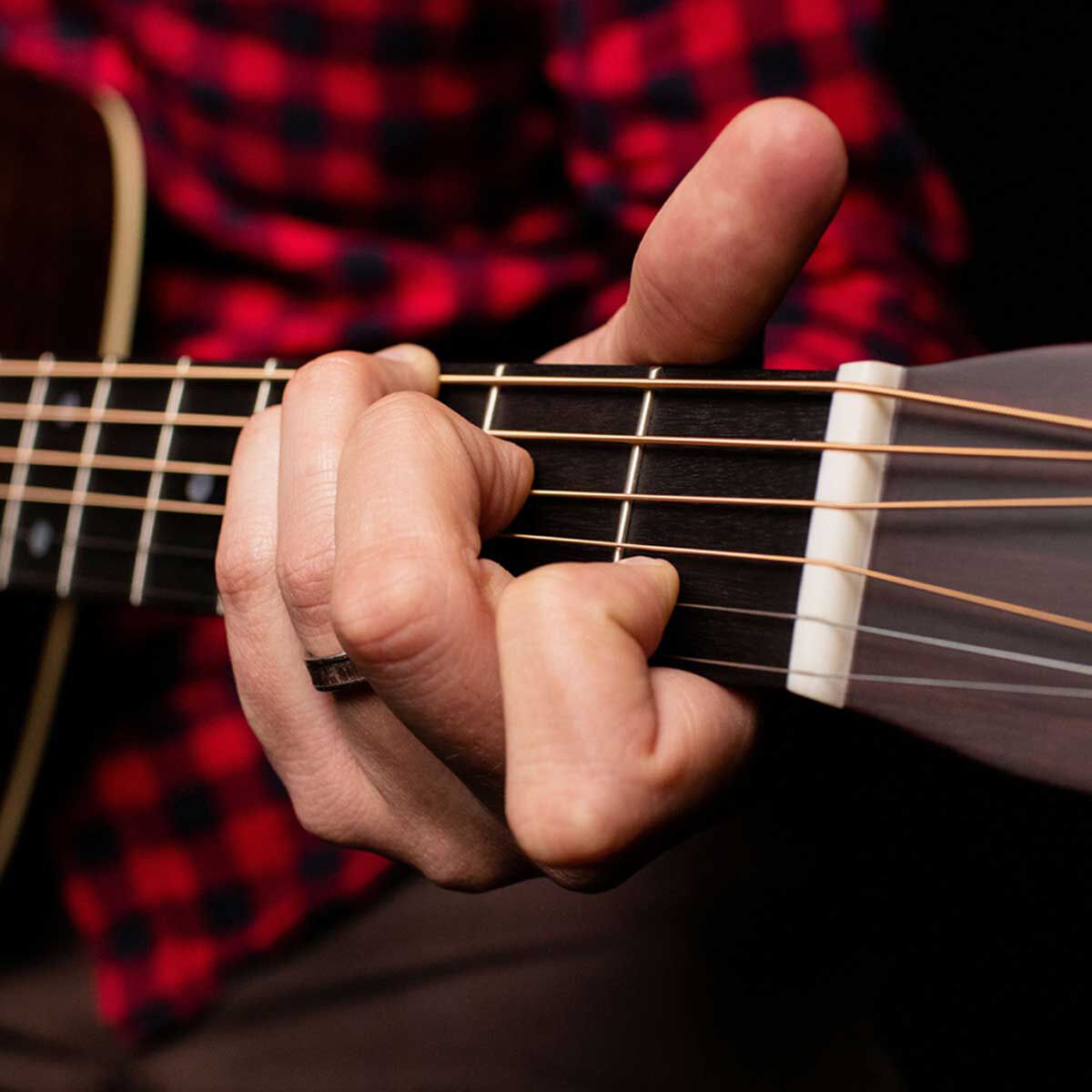
Guitar intonation refers to how accurately the instrument stays in tune as you play notes farther up the fingerboard.
Your open strings can be perfectly tuned, while fretted notes higher on the neck can still sound sharp (too high in pitch) or flat (too low in pitch) if the intonation is off.
Acoustic Guitar String Terms: Gauge, Phosphor Bronze, and More
Strings have their own vocabulary, because apparently the rest of the guitar wasn’t enough.
String Gauge
String gauge means string thickness.
You’ll see terms like extra light, custom light, light, and medium when shopping for acoustic guitar strings.
Different gauges change string tension—essentially how tight or loose the strings feel—and the overall playing feel, and significant changes may require setup adjustments.
If you’re choosing your first replacement set, read our guide to choosing an acoustic guitar string gauge.
Phosphor Bronze
One of the most common acoustic guitar string materials.
Phosphor bronze strings are popular for their versatile, balanced tonal character.
80/20 Bronze
Another familiar acoustic string alloy, typically associated with a bright, crisp character when fresh.
Want to hear and understand the difference? Our guide to acoustic guitar string materials goes much deeper into phosphor bronze and 80/20 bronze.
Treated or Coated Strings
Strings that use a treatment or coating designed to help protect against corrosion and extend useful life.
Martin Authentic Acoustic Lifespan® 2.0 strings are one example.
Restring
To replace the strings on your guitar.
If someone asks when you last restringed or restrung your guitar, they’re asking how old your current strings are.
If the answer is “I got the guitar for Christmas three years ago,” please continue directly to the nearest pack of strings.
Guitar Playing Terms Every Beginner Will Hear
Now that we know the instrument, let’s actually play the thing.
Standard Tuning
The tuning most guitarists learn first:
E–A–D–G–B–E
That’s listed from the lowest-pitched sixth string to the highest-pitched first string.
If tuning still feels mysterious, start with Martin’s step-by-step guide to how to tune an acoustic guitar.
Alternate Tuning
Any tuning that changes one or more strings from standard E–A–D–G–B–E.
Drop D
One of the easiest alternate guitar tunings to try.
Lower the sixth string from E to D:
D–A–D–G–B–E
That’s it.
If that opens a door you want to keep walking through, our beginner’s guide to alternate guitar tunings covers Drop D, open tunings, DADGAD, and more.
Capo
A device that clamps across the strings at a chosen fret, raising their pitch and allowing you to play a song in a different key—or overall pitch range—while continuing to use familiar chord shapes.
Extremely useful.
Extremely easy to misplace.
And when you’re ready to add one to your case, Martin makes its own Guitar Capo, designed for quick one-handed operation and adjustable fit across a variety of guitar neck shapes.
Chord
Multiple notes played together.
Open Chord
A chord that includes one or more strings played without being fretted.
These include many of the first shapes beginners learn.
Cowboy Chords
Informal guitar slang for familiar chords played near the nut that use open, unfretted strings—think G, C, D, A, E, and their friends.
Nobody is required to own boots.
Barre Chord
A chord in which one finger presses across several strings at once while the remaining fingers complete the shape.
Every beginning guitarist eventually meets the F barre chord.
This is a safe space.
Chord Shape
The fingering pattern your hand makes to play a chord.
Voicing
The particular arrangement of notes used to create a chord.
Two musicians can play the same chord using different voicings, giving each version a different character.
Riff
A recognizable musical phrase or repeated pattern that often helps define a song.
Lick
Usually a shorter phrase used within a solo, melody, or improvisation.
The line between riff and lick is not enforced by any governing body.
Run
A sequence of notes played in succession, often connecting chords or sections of a song.
Fill
A short musical phrase used to fill the space between vocal lines, chords, or larger musical ideas.
Lead Guitar
Playing solos, melodies, fills, and other parts designed to stand out individually.
Rhythm Guitar
Playing chords, riffs, and rhythmic accompaniment that support the song.
One player can absolutely do both.
Strumming
Playing across several strings in a rhythmic motion.
Flatpicking
Playing with a flat guitar pick, often involving strong rhythm playing, single-note lines, or quick melodic runs—especially associated with bluegrass music.
Fingerstyle
Playing primarily with your fingers instead of a flat pick.
Fingerpicking
Often used interchangeably with fingerstyle, especially when individual fingers pluck separate strings in a repeating or arranged pattern.
Travis Picking
A fingerpicking approach built around an alternating bass pattern beneath higher notes.
Picking Hand
The hand that picks, plucks, or strums the strings.
Fretting Hand
The hand that presses strings against the fingerboard.
Hammer-On
Sounding one note, then creating a higher note by firmly fretting another note without picking the string again.
Pull-Off
The opposite idea: removing a fretting finger in a controlled way to sound a lower note without picking again.
Slide
Moving a fretted note up or down the fingerboard while maintaining contact with the string.
Slide can also refer to the tube worn over a finger for slide guitar.
Context strikes again.
Bend
Pushing or pulling a string sideways to raise its pitch.
Vibrato
Slightly varying the pitch of a note you’re holding for added expression.
Harmonic
A clear, bell-like note created by lightly touching a string at certain points instead of pressing it fully down to a fret.
Palm Muting
Using part of the picking hand to dampen the strings, producing a tighter, shorter, more rhythmic sound.
Pick
That small object you hold between your fingers to strike the strings.
And yes, even picks get complicated. Thickness, shape, material, and flexibility can all affect feel and sound, which is why we have an entire guitar pick buying guide.
Guitar-Player Slang: Jam, Noodle, Chops, and Woodshed
Now we can get into the language that really makes beginners wonder whether everyone else joined a club without telling them.
Jam
To play music informally with other musicians, often without a rigid plan.
“Want to jam?” generally means “Want to play some music together?”
Jam Session
A gathering where musicians play together, improvise—or make music up in the moment—trade songs, or work through ideas.
Noodling
Casually playing riffs, scales, chords, or random musical ideas without necessarily playing a complete song.
We all do it.
Some of us call it “practicing.”
Chops
Your playing ability or technical skill.
“He’s got chops” is a compliment.
Woodshedding
Practicing intensely, usually to work out something challenging.
You do not need an actual woodshed.
Sit In
To join another artist or band for part of a performance.
Comping
Short for accompanying—playing chords or rhythmic support behind another musician.
When a musician is “in the pocket,” their timing feels locked into the groove.
Groove
The rhythmic feel of a piece of music.
Hard to measure.
Easy to notice when it’s missing.
Shred
To play fast, technically demanding guitar passages.
You can technically shred on an acoustic guitar.
Your fingertips may file a complaint.
What Does Guitar “Tone” Mean?
Here we enter the wonderfully subjective part of guitar terminology.
Two players can hear the exact same acoustic guitar and use different words to describe it.
Neither one necessarily has to be wrong.
Tone
The overall character or quality of the sound.
“How does it sound?” is the question.
Tone is the giant answer.
Warm
Usually describes a smooth sound with plenty of body and less emphasis on sharp, higher-pitched sounds.
This does not mean the guitar is physically warm.
Please do not put it near a radiator.
Bright
A sound with more emphasis on the higher-pitched part of the guitar’s range, often heard as crispness or sparkle.
Balanced
The low, middle, and high parts of the guitar’s sound—often called bass, midrange, and treble—feel relatively even, without one range dominating the others.
Punchy
A quick, strong, well-defined sound, often especially noticeable in the middle part of the guitar’s tonal range.
Boomy
A lot of bass.
Sometimes delicious.
Sometimes too much.
Articulate
Individual notes remain distinct and easy to hear.
Clear
Notes and frequencies sound well defined rather than blurred together.
Muddy
When notes or frequencies blend together so much that definition gets lost.
Mud belongs at music festivals.
Preferably not in your guitar tone.
Dry
Often used to describe a focused, direct sound with fewer extra tones ringing around each note.
Not a humidity recommendation.
Which reminds us…
Humidity
Okay, this one isn’t tone slang, but it matters enough to interrupt ourselves.
Acoustic guitars are affected by changes in humidity. If you own a solid-wood instrument—or really any acoustic you care about—it’s worth learning the basics of proper storage and humidification.
Our acoustic guitar maintenance guide covers humidity, cleaning, storage, and other essentials that can help keep your guitar happy.
Back to tone...
Overtones
Extra tones that ring along with the main note you played, adding richness and complexity to the sound.
Sustain
How long a note continues ringing after you play it.
Attack
The very beginning of the note—the immediate response when you strike the string.
Projection
How effectively a guitar’s sound carries outward and fills a space.
Larger body sizes like a Dreadnought or Jumbo often deliver more power and projection than compact guitars like a 0 or Size 5, though tonewoods, bracing, construction, and playing style all play a role.
A guitar can also sound loud to the player without necessarily carrying across a room in quite the same way.
Resonance
How freely and fully the guitar vibrates when you play, helping notes feel alive and continue ringing through the instrument.
Headroom
How much harder you can play a guitar while it still sounds clear and open. A guitar with lots of headroom can handle stronger picking or strumming without the sound becoming crowded or losing definition.
If someone says a guitar has “a lot of headroom,” they generally mean it keeps responding clearly when played with more force.

Gear and Gigging Terms Beginners Might Hear
You may still be working on your first three chords.
The gear vocabulary is coming for you anyway.
Pickup
A device that captures your instrument’s sound so it can be amplified.
Electronics
The broader system inside an acoustic-electric guitar that may include a pickup, preamp, controls, tuner, or other features.
If you want to understand what those components actually do—and how different Martin systems work—check out our guide to Martin guitar electronics.
Preamp
An electronic component that strengthens and can help shape the sound coming from the pickup before it reaches an amplifier, PA, or recording gear.
PA
Short for public address system.
At a live show, an acoustic-electric guitar may be connected to the PA so the audience can hear it through the venue’s speakers.
DI
Short for direct injection or direct input.
A DI box is commonly used to help connect instruments to live sound or recording equipment.
Feedback
That loud howl that can happen when amplified sound gets picked back up and repeatedly re-amplified.
Nobody likes it.
Everybody looks at the sound engineer.
Gig
A live performance.
Gig Bag
A padded soft case used to carry an instrument.
Owning one does not automatically result in gigs.
We checked.
Hardshell Case
A rigid case that provides additional physical protection for your guitar.
Guitar-Shop Slang You’re Going to Hear Eventually
These are the phrases that may never show up on a specification sheet but absolutely show up in guitar conversations.
“It Plays Fast”
The player finds the neck, action, fretboard, or overall setup comfortable for quick movement.
The guitar itself has not achieved locomotion.
“It Opened Up”
A phrase some players use when they feel an acoustic guitar has become more responsive or developed in sound after being played over time.
“It Cuts Through the Mix”
The guitar remains easy to hear in the combined sound—or mix—of all the instruments in a band or recording.
“It Sits Well in the Mix”
The guitar finds its own sonic space without competing too heavily with the other instruments.
“It’s a Cannon”
Complimentary guitar slang for an instrument with a particularly powerful, projecting voice.
Dreadnoughts hear this a lot.
Couch Guitar
A comfortable, convenient guitar you keep close by for casual playing around the house.
A Little Martin makes a pretty convincing candidate.
Beater
A guitar a player is comfortable taking almost anywhere without obsessing over every little ding or scratch.
This does not necessarily mean it is a bad guitar.
Often, it means the exact opposite: it gets played constantly.
Player or Player-Grade
Usually describes an instrument valued for how well it plays and sounds rather than for perfect cosmetic or collectible condition.
Case Queen
A guitar that spends most of its life carefully preserved in its case.
At Martin, we’re pretty fond of the idea that guitars are made to be played.
Pre-War
When guitar collectors say “pre-war Martin,” they’re generally referring to instruments made before the United States entered World War II—an era highly prized for historically significant Martin guitars and construction methods.
Golden Era
A term used for Martin’s revered period from the late 1920s through 1942, when innovations in design, materials, and craftsmanship produced many of the pre-war guitars that remain among the most sought-after Martins today.
Vintage
Usually refers to an older instrument from a previous era, although exactly how old something needs to be before people call it “vintage” can start an argument remarkably quickly.
Gear Acquisition Syndrome (GAS)
The mysterious conviction that another guitar, capo, pick, strap, set of strings, or accessory is definitely the final missing ingredient.
There is no known cure.
The author of this blog can confirm.
What Do Martin Guitar Names Mean?
If guitar slang is confusing, a name like 000-10E probably isn’t helping—but don’t let the letters and numbers scare you. It’s still a great guitar.
Fortunately, many Martin model names contain useful information once you know how to read them.
Take the D-28.
The D refers to the Dreadnought body size, while 28 identifies its style designation. A Martin style can encompass a broader combination of tonewoods, binding (the trim around the edges of the guitar), inlays (decorative details set into the instrument), rosette details (the decoration around the soundhole), finish, and other appointments—or design and cosmetic features. On today’s D-28, for example, some of those Style 28 characteristics include solid East Indian rosewood back and sides, antique white binding, a multi-stripe rosette, and mother-of-pearl fingerboard inlays.
A 000-18, meanwhile, combines a 000 body with Style 18. Some of its Style 18 characteristics include solid mahogany back and sides, black binding, an Old Style 18 rosette, and abalone fingerboard inlays.
So those numbers aren’t just model numbers—they can give you clues about the materials, look, and overall style of the guitar before you even open the full spec sheet.
An E commonly indicates electronics, while other letters and numbers may identify cutaways, series, body sizes, construction details, or special model families.
Martin naming conventions have evolved throughout the company’s history, so there isn’t one universal equation that decodes every instrument ever built. But learning the basics makes browsing acoustic guitars much easier.
For the full decoder ring, read What Does D-28 Really Mean? A Guide to Martin’s Naming Conventions.

What’s a Good Martin Guitar for a Beginner?
Here’s one guitar term we’d argue matters more than almost everything above:
The guitar you actually want to play.
The best acoustic guitar for a beginner should make you want to pick it up. Comfort, body size, scale length, playability, tone, budget, and personal taste all matter.
And there’s no rule saying your first acoustic guitar has to be something you plan to outgrow.
Martin offers plenty of places to start.
The LX Series, better known as the Little Martin, provides a compact body and shorter scale that can make it especially approachable for younger players, beginners, travelers, or anyone who simply prefers a smaller guitar.
The Junior Series is another great option for players who want a compact, comfortable feel while moving closer to the experience of a full-size acoustic guitar, while the X Series offers a wide range of accessible models, body shapes, and features for players looking to get started with a Martin.
If you want to learn more about choosing your first instrument, our guide to the best Martin guitars for beginners walks through some of the things new players should consider.
For players ready to step into an all-solid-wood acoustic with even more choices in body shape, tonewood, styling, and live-performance features, the Road Series offers another strong place to start. The refreshed lineup gives players multiple paths depending on the kind of guitar they want and where their music is headed. Explore the thinking behind it in Your Road to What’s Next: Introducing the Refreshed Martin Road Series.
And if your budget allows—or you simply know you want something you can grow with for a very long time—you can absolutely start higher in the Martin lineup. There’s nothing stopping a first-time player from jumping into a Nazareth-made guitar from the 15 Series or even the trusted and iconic Standard Series. A great first guitar doesn’t have to be a temporary one.
Ultimately, though, specs and series names only tell you so much.
Visit a Martin dealer. Hold a few guitars. Try different body sizes. Feel different necks. Strum some chords—even if you only know two.
The guitar that makes you want to learn the third one is probably worth paying attention to.
Still Learning Guitar? Martin Has Plenty More to Help
Nobody picks up a guitar already knowing the difference between action and intonation, 000 and OM, or phosphor bronze and 80/20 bronze.
You learn the language the same way you learn the instrument: one piece at a time.
The Martin Tips & Tutorials library has beginner guitar resources covering everything from tuning and body sizes to fret buzz, playability, maintenance, and guitar parts.
You’ll also find lessons, product demonstrations, artist performances, factory stories, how-tos, and Pro Tips on the Martin Guitar YouTube channel, along with more deep dives right here on the Martin blog.
And if you’re ready for more structured guitar lessons, there’s the Martin Lesson Room, powered by TrueFire. It includes video-based lessons and learning tools designed to help guitarists work through songs, techniques, and new skills at their own pace.
Members of Martin Backstage can access select Martin Lesson Room content along with other member benefits and exclusive resources.
Because the funny thing about all this guitar jargon is that eventually, it stops sounding like jargon.
One day you’ll walk into a guitar shop and casually say:
“I’m looking for a short-scale 000 with a comfortable neck profile, scalloped X-bracing, and a warm but articulate tone with good projection and plenty of headroom.”
And then it hits you.
Oh no.
You’re a guitar person now.
Welcome to the club.
Until next time, happy playing!